


Those who loves this song love the sinking of it. Not the drowning, the letting-go. You are drawn off the edge by someone’s eyes, over a cliff, down through water that keeps getting darker, and the strange grace of it is that you go willingly. I’d be crazy not to follow. The song does not fight the descent. It sinks with its eyes open. And when I finally saw the sonicture, the thing I most wanted to find was the darkness closing over, and there it is, not in the harmony, not in the volume, but in the light.
Start at the surface. Nearly a minute passes before the voice arrives, the longest silence the thread keeps, the guitars of the title cycling and interlocking alone. This is the ‘Arpeggi,’ three parts plus keys spinning short rising figures that don’t riff so much as accumulate, and you can see them accumulate: the whole portrait is woven from thin concentric threads, hundreds of them, layered like the surface of moving water catching sun. Eight hundred rings in five minutes, a ring for every attack, which is why this portrait glows the way it does. The playing never stops arriving, so the weave never opens. Almost never; hold that thought.
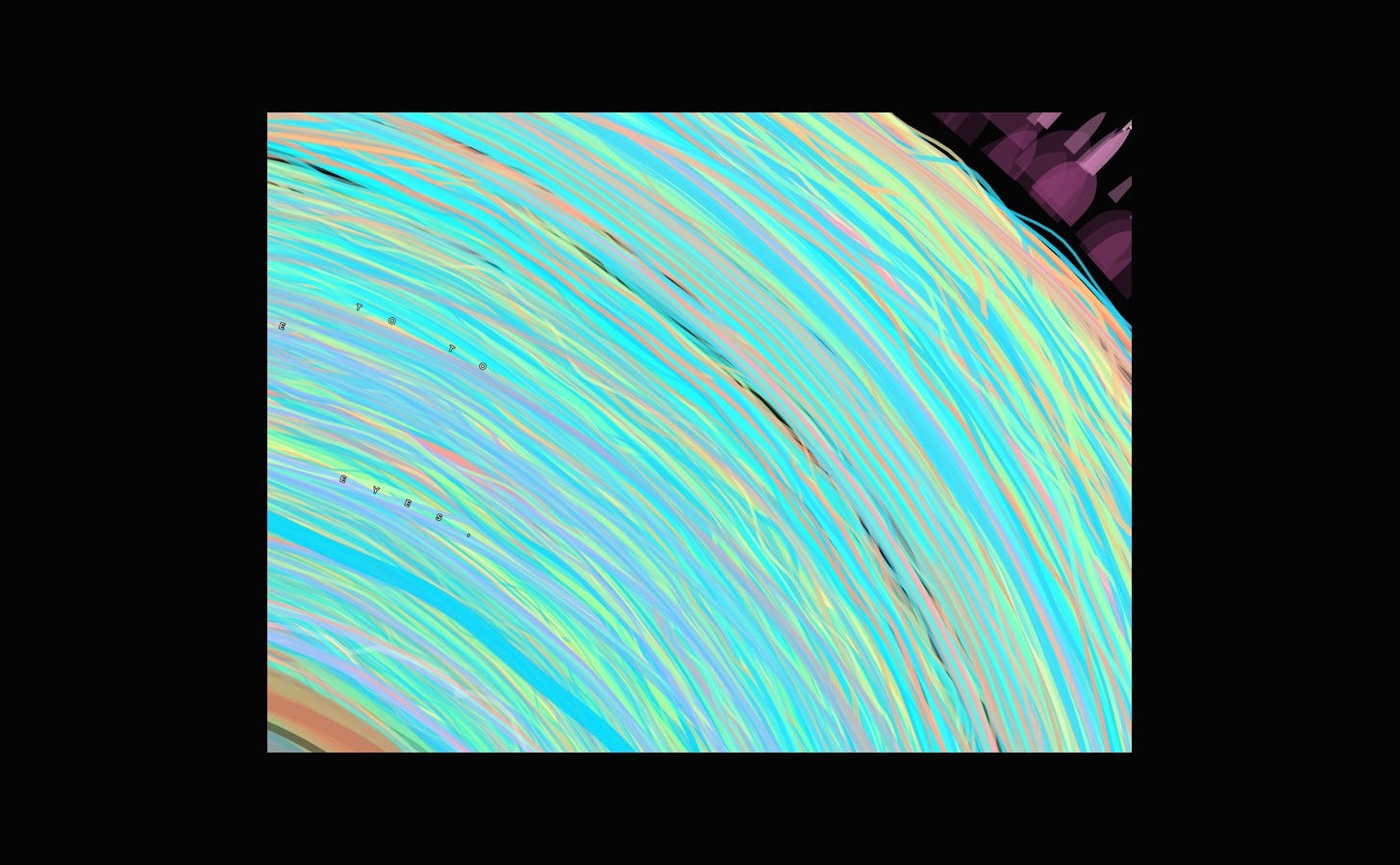
The opening rings are the brightest thing in the picture. The spectral centre of that first stretch sits near 6,665 hertz, which is the glassy top of hearing, cymbal air and pick attack, the water’s lit surface. Then the descent begins and the light starts to fail, section by section, settling into the middle register and staying there, bright enough to see by while the voice enters, your eyes, they turn me, and the guitars keep their patient cycling. This is the body of the swim. The surface is already gone above you.
Underneath all of it, the pulse. Radiohead built this on a drum feel so even it’s become the thing people play it live for, two kits locked together, and the percussion crown around the rim shows why it reads as motion rather than beat: the transient energy is split almost evenly across low, mid, and high, no single band dominates, no backbeat spikes. It’s a texture, not a hit. The marks are drawn in violet and orchid and pale pink, the centre’s complement, ringing the whole circle like a current you’re moving through rather than a rhythm you’re standing on.
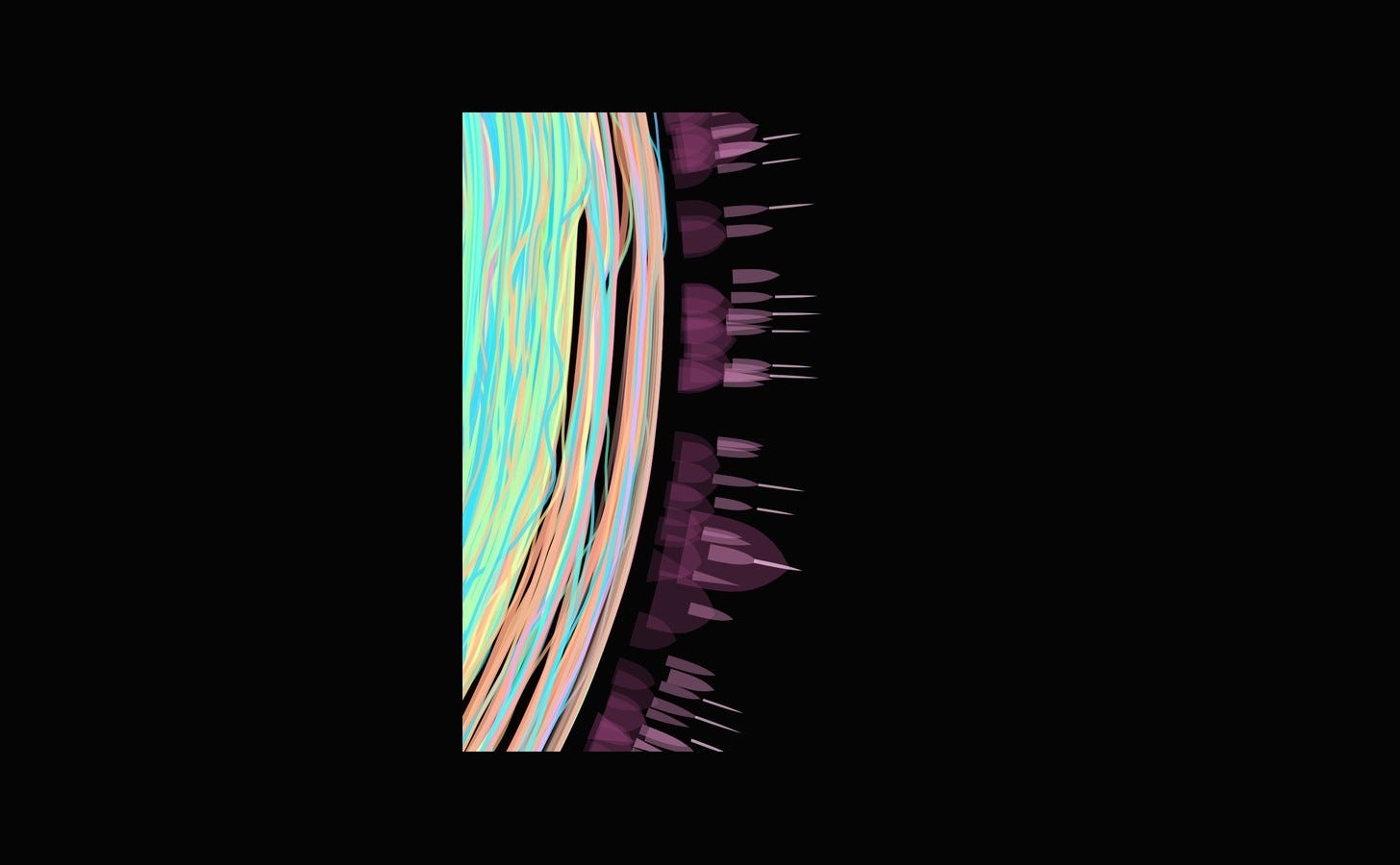
And notice what the harmony does not do. The rings barely lean; the field stays anchored on A, spring green, beginning to end, the tonic pulling everything gently back toward centre. So the sinking is not a chord change. Superstition, elsewhere in this gallery, circles its one riff and never leaves home. Weird Fishes never leaves home either, and still it leaves. Downward. Into darkness.
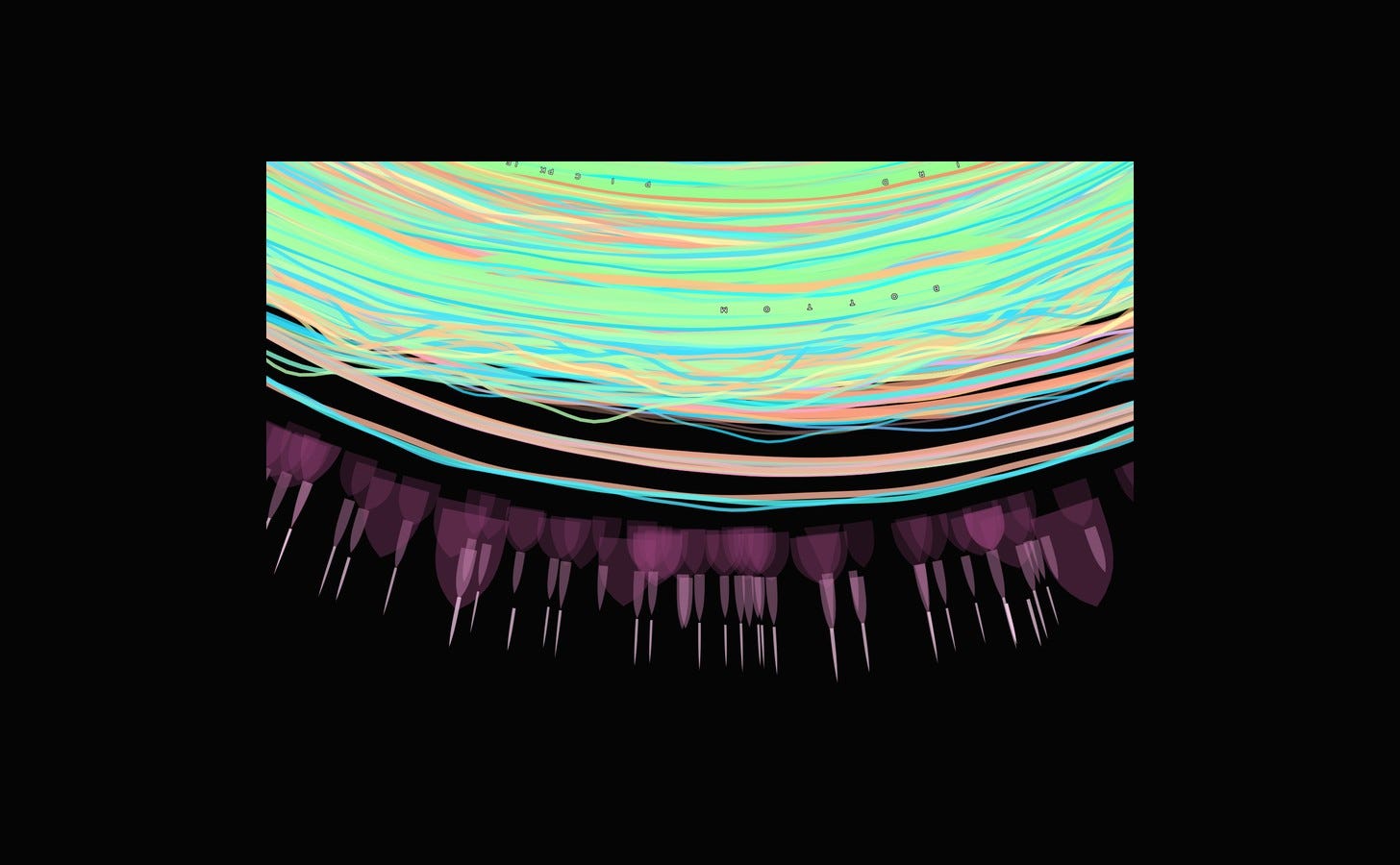
You will not see night fall from across the room; the weave is too bright for that, and some of what a sonicture maps sits at the edge of what an eye can catch. But the instruments saw it, and once you know where to look, so can you. About two-thirds of the way through, right where I follow to the edge of the earth and fall off, the floor drops. Three sections in a row lose their brightness, the spectral centre falling from that glassy 6,665 down near 1,000 hertz, below where treble lives, the register of deep water. The famous drop-out, where the band falls away and the voice is left suspended, is not quiet in the sonicture so much as dark in exactly this sense: the sound sinks below where the light can reach, the way colour drains out of deep water. On the page it is small and true. The rings of those sections thin by a third, the finest threads in the circle, and near the portrait’s lower edge the weave finally does what it refuses to do everywhere else: it opens. Bare single threads over black, the void showing through. The engraving marks the spot, hit the bottom, written on the very rings where the song touches it.
And the voice floats there in the dark. The white spiral thread, the vocal's drawn contour, holds through this suspended stretch even as everything around it thins, a voice that spans barely an octave all song and does not reach for more now. Yeah, everybody leaves if they get the chance. And this is my chance. It's the most naked the picture ever gets: white thread, thin rings, no light.
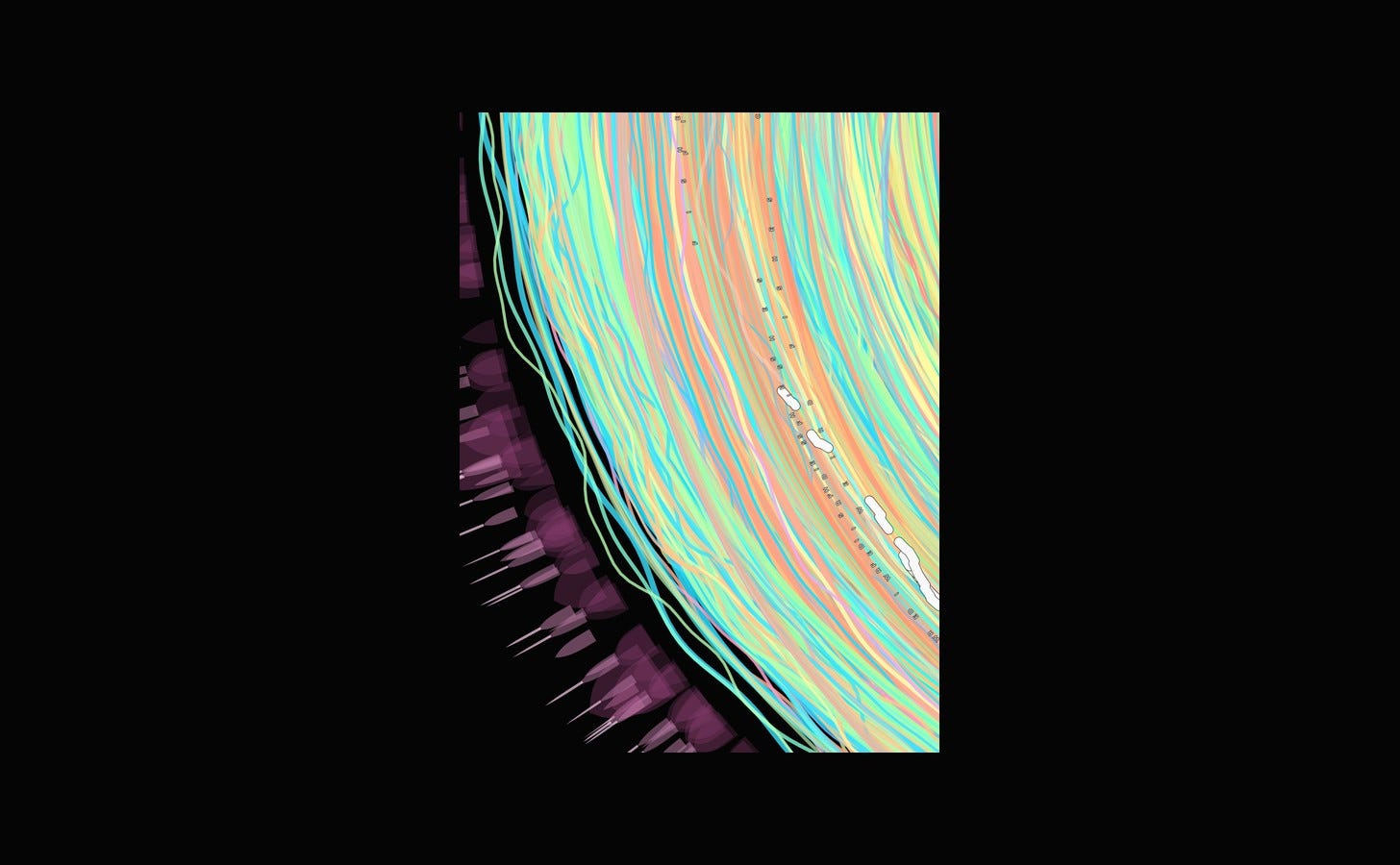
Then the escape. The single loudest moment of the whole song arrives at about three-quarters through, not at a chorus, not at the surface, but just past the bottom, on the turn back up. I’ll hit the bottom, hit the bottom and escape. The pulse returns, the brightness climbs back toward daylight, the rings swell to their thickest anywhere, and the peak of the song is revealed as the kick off the ocean floor. You had to go all the way down to find the pressure to push off.
That’s the reading only this song carries. Every other descent song I know earns its darkness through harmony, a slide to a minor place, a chord that won’t resolve. Weird Fishes refuses that. It keeps its tonic from the cliff’s edge to the escape, keeps its dynamics inside a three-decibel band, flat as still water, and takes you down anyway, because the darkness it uses is the one that’s actually in deep water: the light failing, register by register, until you touch bottom and turn, blind, toward the surface. The image ends where the song does. A pale green eye at the dead centre, and everything spiralling out from it, back up toward the light.
Escape.
every mark comes from the song.
to read a sonicture: learn · to watch one drawn: reveal