


Beth Orton called this song ‘a celebration of moving out of the holding pattern fear keeps us in.’ The holding pattern is right there in the grammar. I’ve been waiting for the hurting to stop. I’ve been waiting at the edge of a dream. Line after line begins in that same suspended tense, the present perfect of someone who has been doing one thing for so long it has become a posture. The sonicture shows me the posture, and then it shows me the moment she leaves it.
Start with where the strain actually lives. The wobble, the ring edges gone wavy instead of clean, is not saved for a climax here. It is at its absolute maximum in the opening, about twenty-six seconds in, while the piano is still spare and lovelorn and the voice is still singing the word waiting. Read the envelope down the sections and it only ever decays: from full instability at the top to roughly a quarter of that by the last third. This is the inversion that makes the song itself. Many records hide their tension and release it late. Waiting states its tension out loud, immediately, in words, and then spends four and a half minutes letting the edges go smooth.
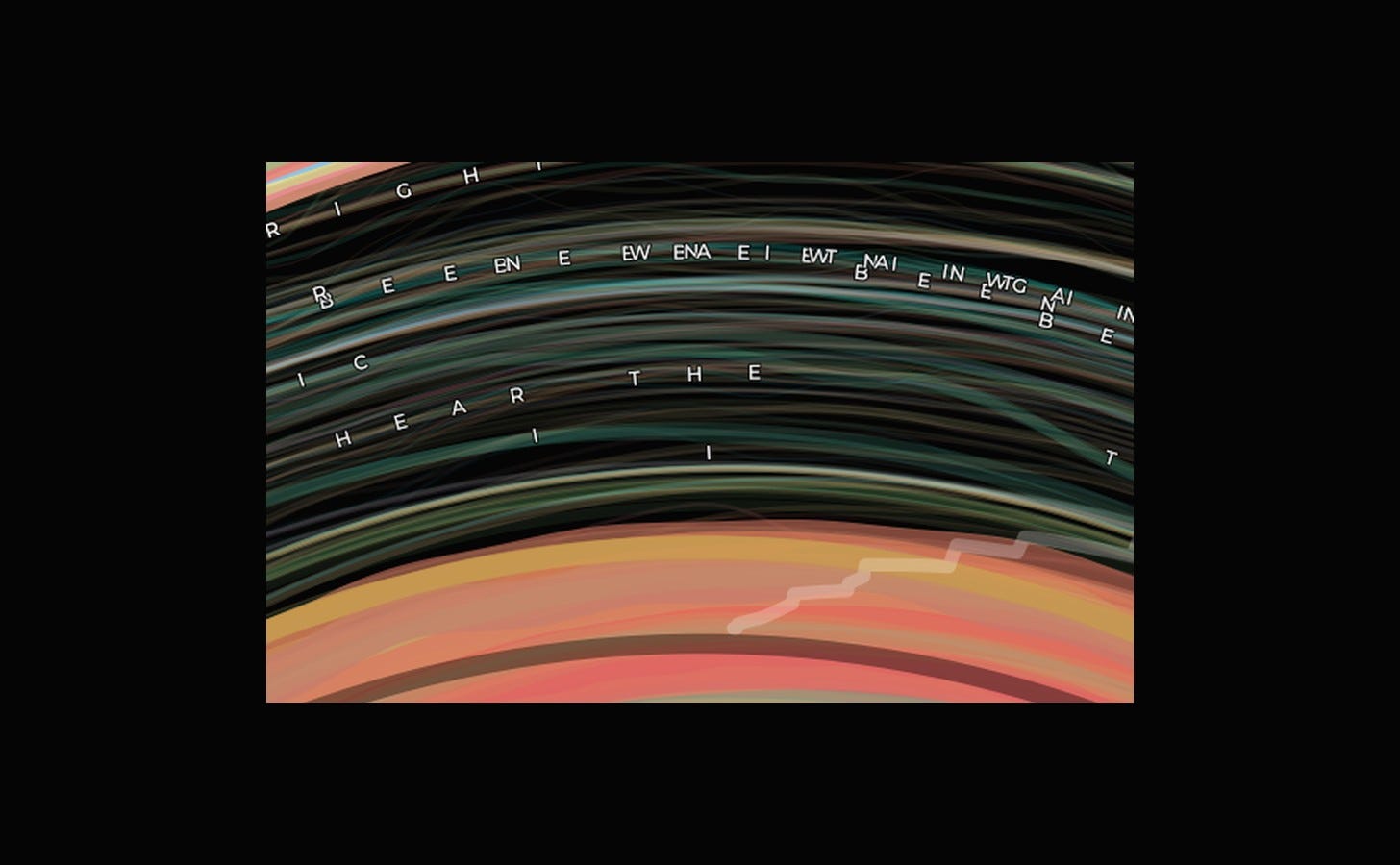
Look at how thin those opening rings are. The first two sections sit at barely half the loudness of everything that follows, and once the swell arrives it never drops back. So the early rings are narrow bands with a lot of black around them, and that darkness has meaning: it is the negative space of a woman alone at a piano, before the scene fills. The press described the song beginning as a spare ballad and swelling into a jazzy cacophony, and the swell is locatable to the eye. It is not a gradual bloom. It is a threshold, crossed once, and held.
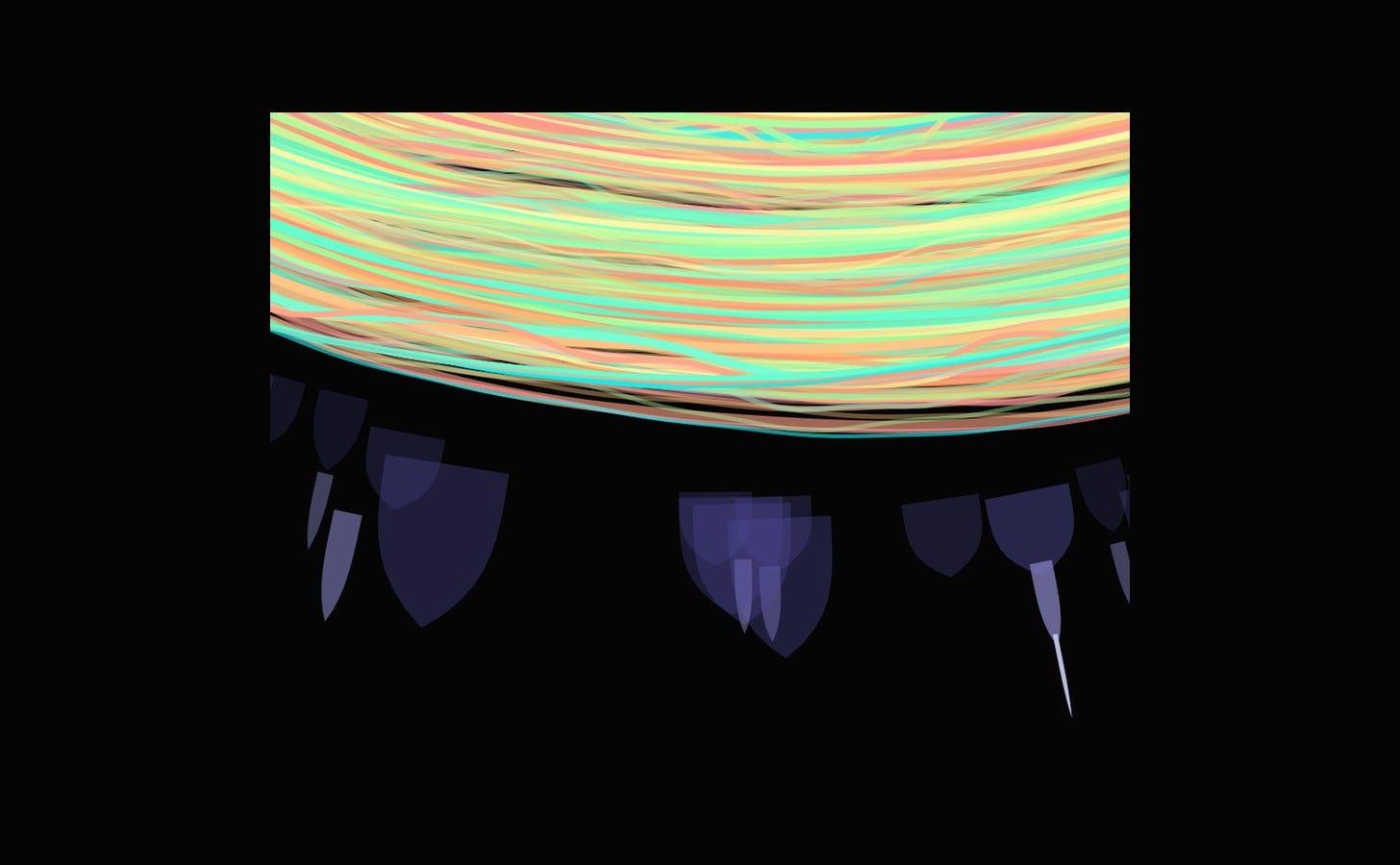
The white spiral thread, the vocal contour, tells the same story from the other side. It is front-loaded. A third of the opening section carries a held vocal line; by the back half the thread has thinned almost to nothing, one section nearly empty, with the longest silence, more than fifteen seconds of it, opening up around 3:39. Here is the thing that survives the waiting: as the voice recedes, the music does not recede with it. It arrives. The percussion marks, those violet spikes radiating from the rim, cool against the coral field, keep no clock: their scatter is the song’s fingerprint. Counted against the timeline, though, the story is unmistakable: the strikes arrive three times as densely in the final stretch, heaviest exactly where the singing has stopped. The band gets loud precisely when she goes quiet.
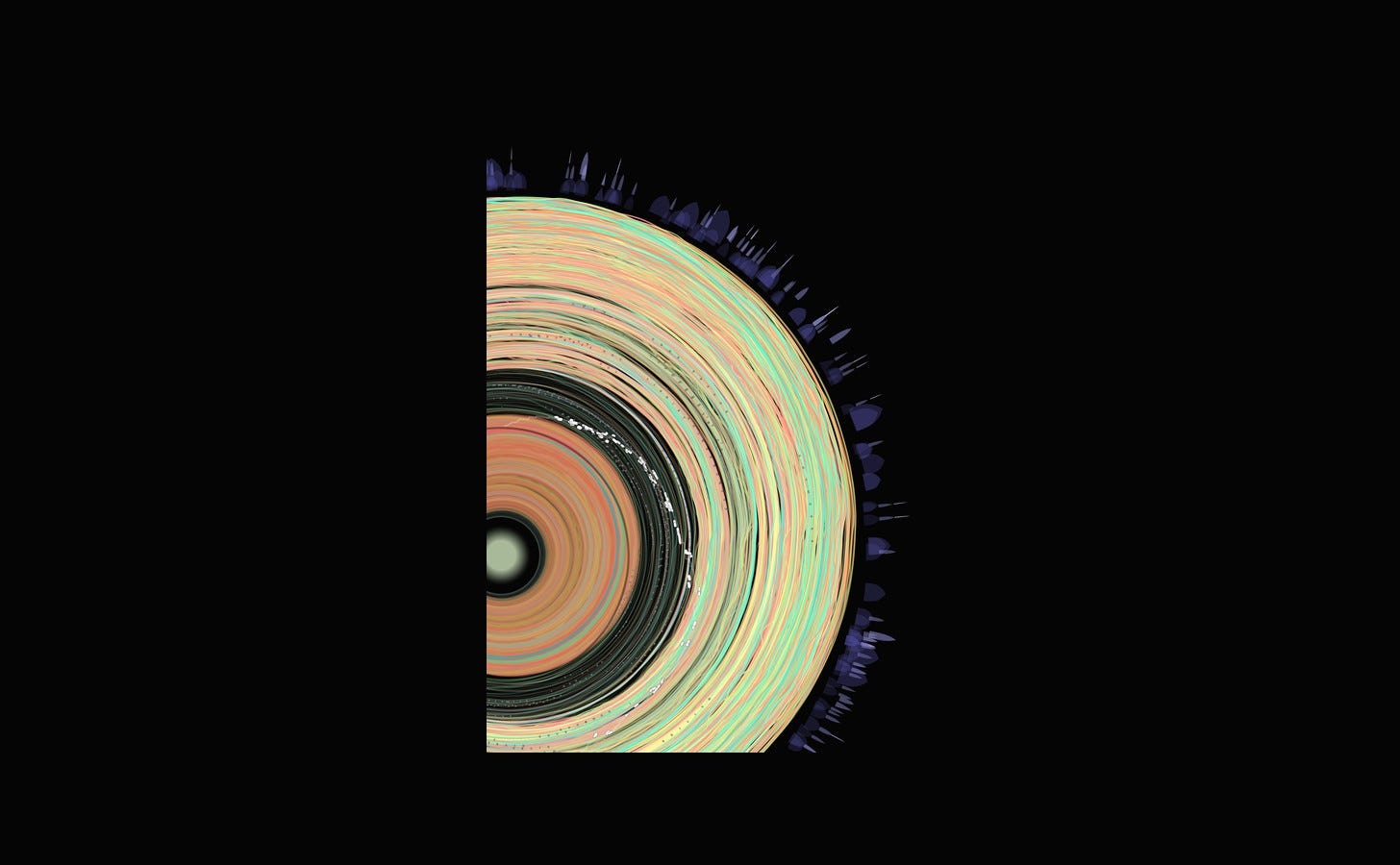
Why would a singer fall silent into her own crescendo? Because she is not waiting anymore. She is dancing. Watch what the lyric does with a single sentence. Early, in the conditional, in the hoped-for future: To put the best dress back on. To catch a favourite song. An infinitive is a promise you have not kept. Then, near the end, the same images return with the tense changed: I put the best dress back on. I caught a favourite song. And I danced my way home to your love. The wish becomes the deed. And the geometry keeps time with the grammar, the loudest moment of the entire song falls almost exactly there, nine-tenths of the way through, on I danced my way home. The dynamic peak is not a chorus hook. It is the sound of the holding pattern breaking.
The palette keeps its ground through all of it. The coral of C major sits warm at the center with gold-green and amber, the D and G, braided through every ring. But listen to which pitch leans where. In the first half the harmony pulls toward D, the second scale degree, the note that suspends and does not resolve; in the second half it settles toward G, the dominant, the note that finally wants to go home. It is a small motion, a modest lean off the tonic axis, but it is the right one: the harmony spends the front of the song hovering a step above rest and the back of it turning toward the door. I've been hovering around like a ghost, she sings early, and the harmony hovers with her.
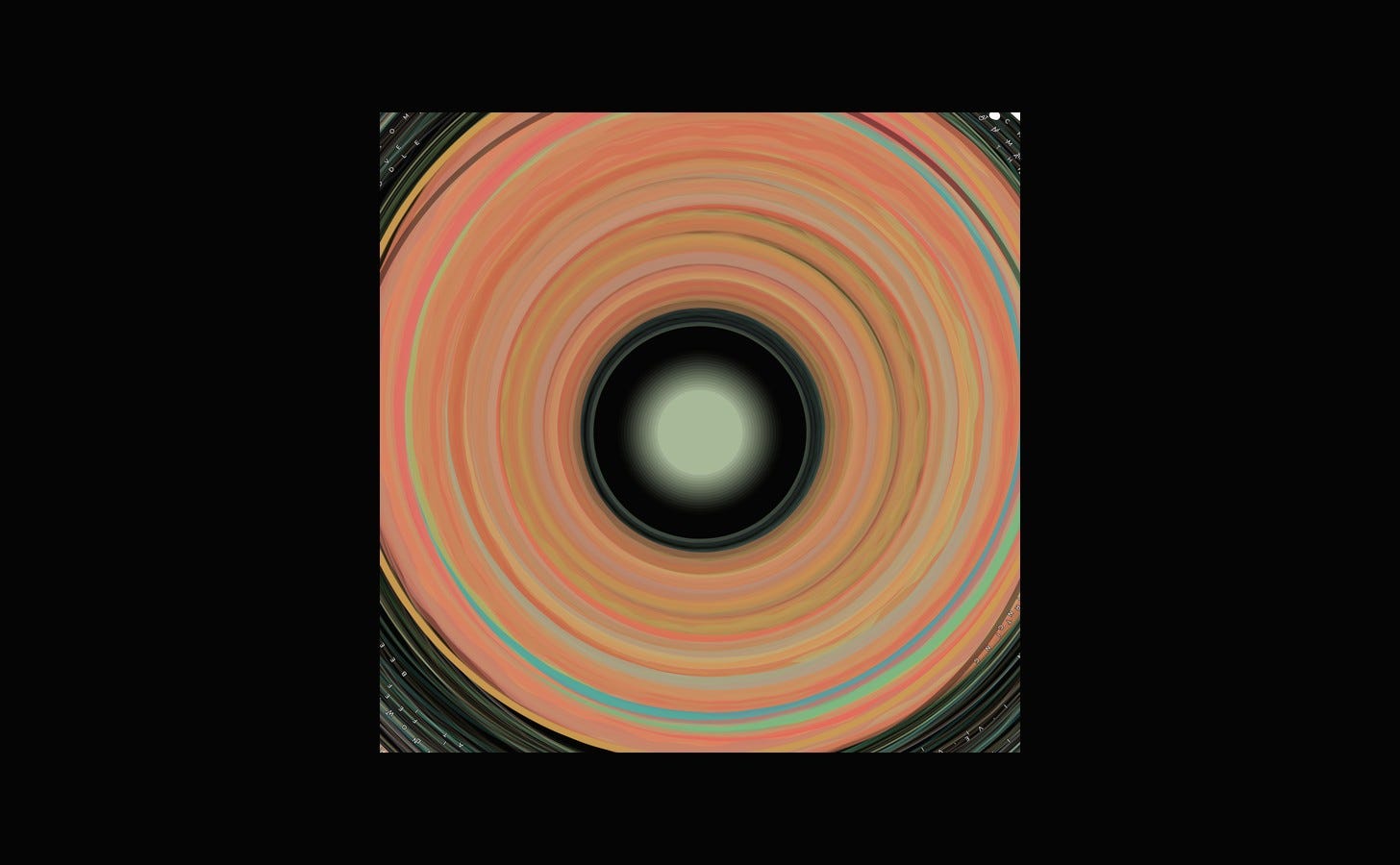
By the close the voice returns, but only to repeat the three words the whole song has been built on, I've been waiting, I've been waiting, and by now the rings beneath them are steady, thick, unwavering. The wobble that opened the song has flattened out almost entirely. She is still saying she has been waiting. She just isn't waiting anymore, and every clean edge in the outer half of the portrait proves it. The waiting became a place she finally danced her way out of. To jump and fly and find my beautiful wings, the sonicture shows she found them not by singing harder, but by trusting the world to carry her once she stopped holding her breath.