


Instant recognition. Four bars of drum groove, then the Clavinet lurches in, and the body decides something the mind hasn’t caught up to yet. Superstition is one of the most physical records ever made, and the strange, wonderful secret the sonicture tells is that all that motion is running in place.
Look at the hub. The center holds a warm amber-and-coral core, and the pitch content that feeds it barely changes from the first second to the last. The chroma reads codominant Bb and F, dusty rose and blush. But the riff itself lives in E flat minor, and Bb and F are the fifth and the ninth it hammers, the two pitches that, against an Eb home, refuse to resolve. The song never sounds like it arrives anywhere because harmonically it doesn’t: it hovers on the dominant’s edge and calls that hovering the groove. Harmonic velocity, the rate at which new pitches enter the palette and old ones leave it, reads as close to zero as songs get. Thirteen sections, and the tonal address never moves house.
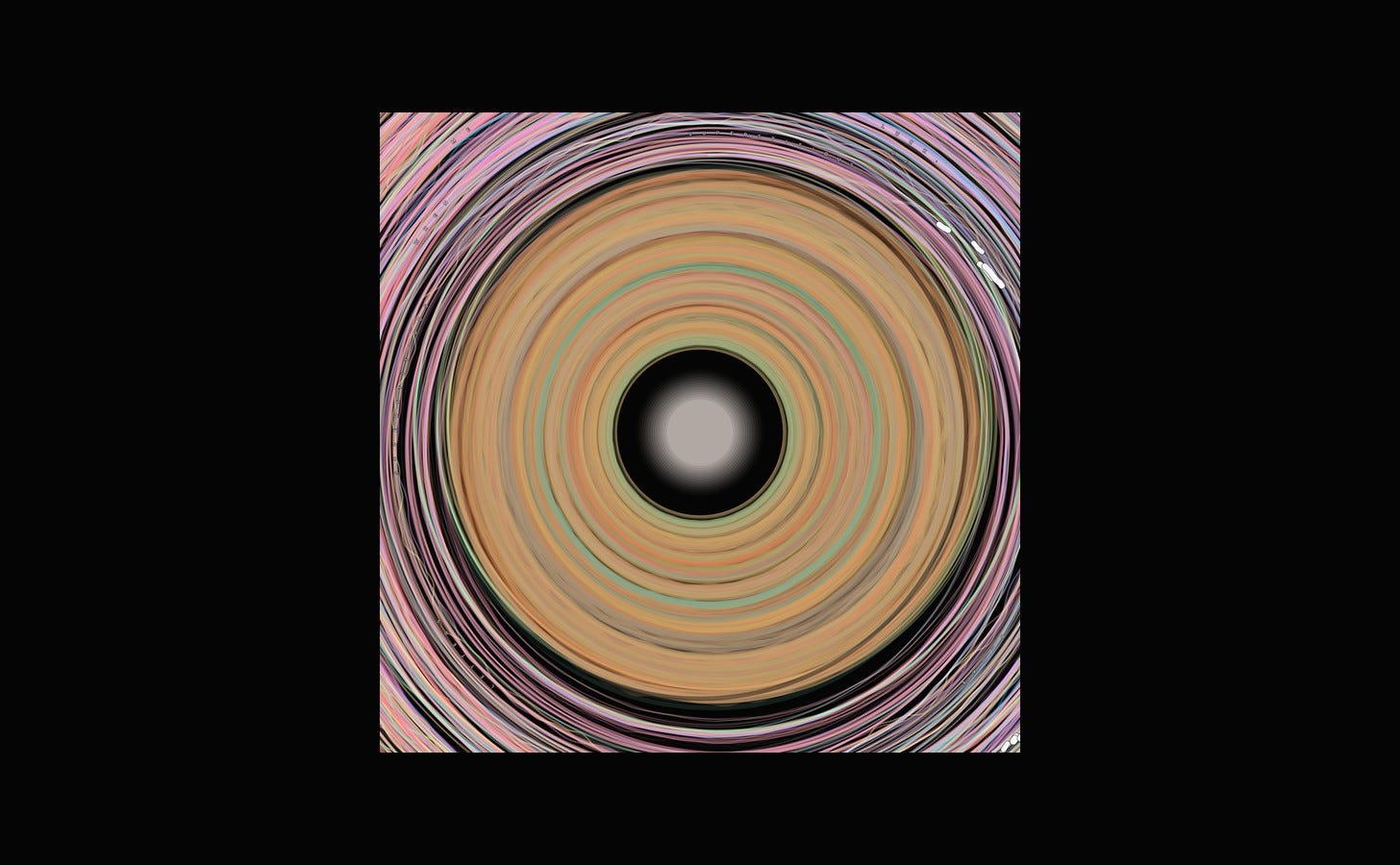
That’s the record’s whole architecture, and it’s why it feels the way it feels. The Clavinet riff, that Hohner sound Stevie tracked himself, drums and all, before the horns arrived, is a wheel. It doesn’t travel toward a chorus that lifts you into a new key; it turns. And a song called Superstition built as a wheel is a song whose form has read its own lyric. Very superstitious, writings on the wall: the verses are a catalogue of signs, each one a loop a mind can get caught in, and Stevie names the mechanism outright, when you believe in things that you don’t understand, then you suffer. Belief in things you don’t understand is circular by nature: the omen confirms the fear, the fear confirms the omen. The geometry loops for the same reason the thinking does. There’s no exit written into either.
So where does the drama live, if not in the harmony? In the edge. Look at the transients: 859 onsets against 441 theoretical beats, nearly two hits for every pulse. That’s the syncopation you can’t sit still through, and it radiates as the spiky teal fringe crowding the outer rim, dense and mid-weighted where the snare-and-Clavinet interplay does its work. Everything this song has to say about momentum, it says out here at the edge, in rhythm, because it has forsworn saying it in the center, in harmony.
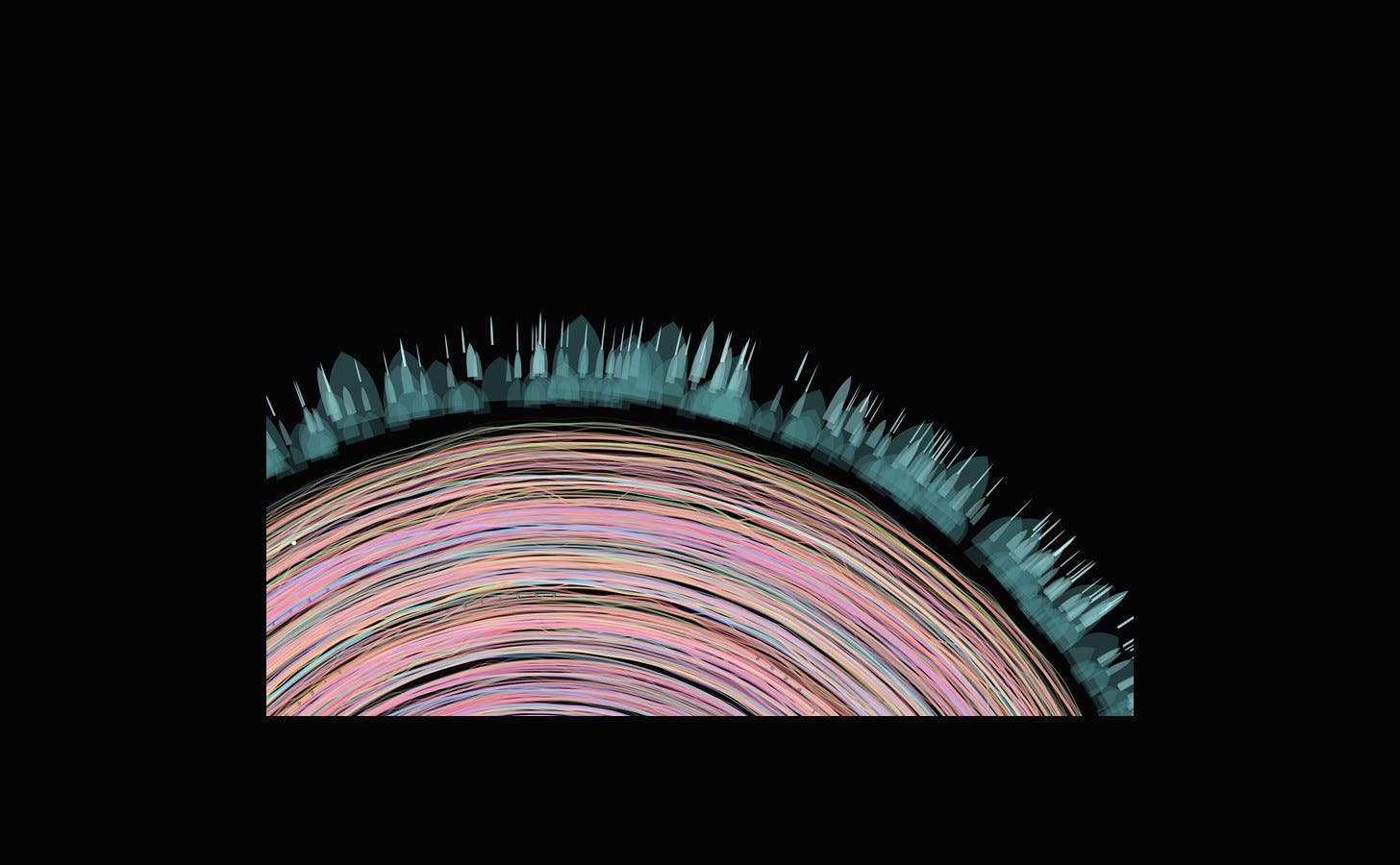
And the reason that interplay is so airtight: it is one person. Stevie played the drums, the Clavinet, the Moog bass; the entire rhythmic machine on this record is a single musician overdubbing himself, which is why the fringe has no seams. There is no drummer chasing a keyboardist. There is one nervous system running the whole groove, and the spikes prove it, evenly furious all the way around.
The dynamics confirm the refusal to climb. The loudest moment sits mid-song, dead center, not a destination but the top of a wheel that was always going to come back around, and the whole span from quietest to loudest is 4.2 dB. A groove doesn’t crescendo; it rides. The rings hold a nearly uniform thickness from rim to core, the visual signature of a track that found its level in the first bar and never once needed to raise its voice to keep you.
Then there’s the one thing that does change. Read the rings from the center out, beginning to end. The early and middle going is unstable: the tension envelope opens near its ceiling and peaks around the song’s two-thirds mark, the ring edges wavy with the blue-note friction of that E flat minor figure grinding against the warm Bb-and-F field it refuses to resolve into. Then the edges steady toward the rim, a settling the measurement catches even where the eye cannot: tension falls to its lowest late in the run before one small closing lift. The song doesn’t resolve its harmony, it can’t, it never left. What settles is the ear. We stop bracing against the ambiguity and simply live inside the turn.
And the voice? A thin white thread, entering only after the drums and Clavinet have run the opening stretch alone; the groove earns its authority before the lyric shows up. On a track where one man played nearly every part, the sung line isn't the engine, the groove is the engine, and the voice is the witness riding on top of it, warning us about the very machinery it's dancing in. And the witness isn't preaching from outside the wheel. He's in it. Keep me in a daydream, keep me going strong, the second verse pleads, asking the spell to hold, and then, quieter and worse, you don't want to save me, sad is my song. The one voice on the record knows firsthand what the spinning costs. But watch how far it reaches: the vocal spans thirty-seven semitones, better than three octaves, from conversational verse phrasing to the scalding wails up top. That reach is the one thing in the song that actually travels. The harmony stays home, the volume stays home, the groove circles in place, and Stevie's voice is the only thing with somewhere to go.
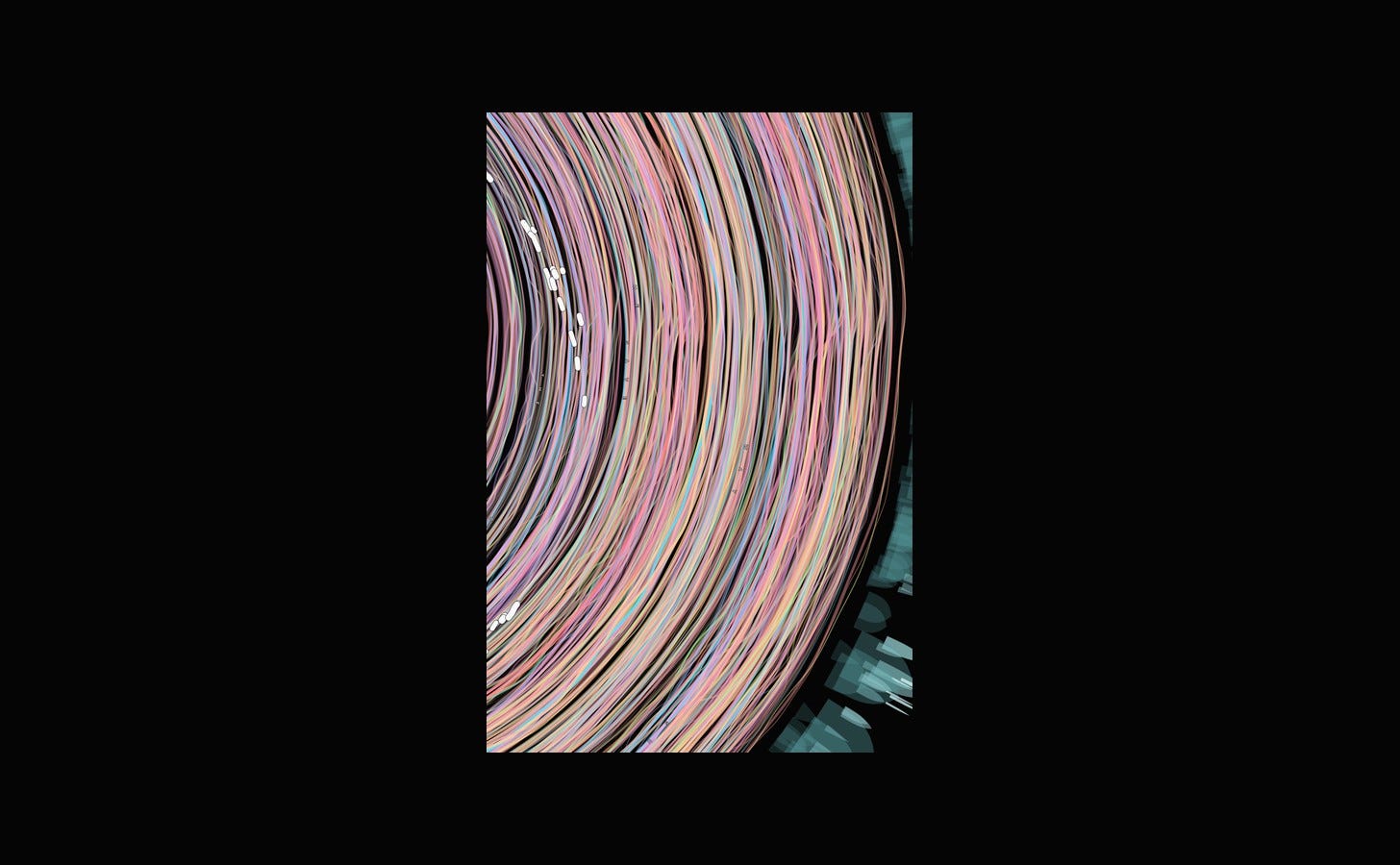
That's the recognition the picture hands back. We always thought this song was taking us somewhere, because nothing that funky could possibly be standing still. But it never leaves its two-pitch orbit. It just turns, and turns, and dares you not to move with it, which is exactly what a superstition does. Superstition ain't the way: four and a half minutes of warning that belief in what we don't understand brings suffering, delivered as the one spell nobody has ever wanted broken. We believe him. And we dance anyway.
every mark comes from the song.
to read a sonicture: learn · to watch one drawn: reveal