



The trick of ‘Strange Currencies’ is that the man singing it has already decided how it will end. These words, ‘You will be mine’, All the time. Not a wish. A verdict. He says it the way you’d read a fact off a page, and he says it again, and again, because saying it is the only power he has over a person who has given him no reason to believe it.
The sonicture shows a man holding on. Look at the harmony first, because it is what he will not release.

Two colours lead the field, coral and amber, C and G, tied so closely neither one wins. Both halves of the song sit on the same two pitches; the harmonic velocity, the rate of pitch change, barely registers. In another song you’d call this rest, home, a settled key. Here it is a grip. The progression cycles under a 6/8 sway and arrives nowhere new because he won’t let it. To move harmonically would be to admit the situation has changed, and the whole song is a refusal to admit that.
But the edges give him away.

Ring after ring turns wavy instead of clean. This is not concealed tension, nothing about this song is concealed. The tremolo guitar shudders in the open, its strain sitting on the surface of every held note. Insisting you will be mine does not make it steady; the harmony holds still while the edges shake, and that contradiction is the record’s whole emotional truth. He has decided. But he is not calm.
The tremolo also explains the shimmer. The track registers many more attacks than there are beats, a wash of that 6/8 subdivision that never stops filling the space. It’s the sound of a mind that won’t go quiet, running the same scene over and over.
Then, at the exact center of the song, tension peaks, and the song answers by emptying out. At 2:09 the drums stop. And for seventeen seconds, the only stretch like it between the lead-in and the fade, there is not one strike.
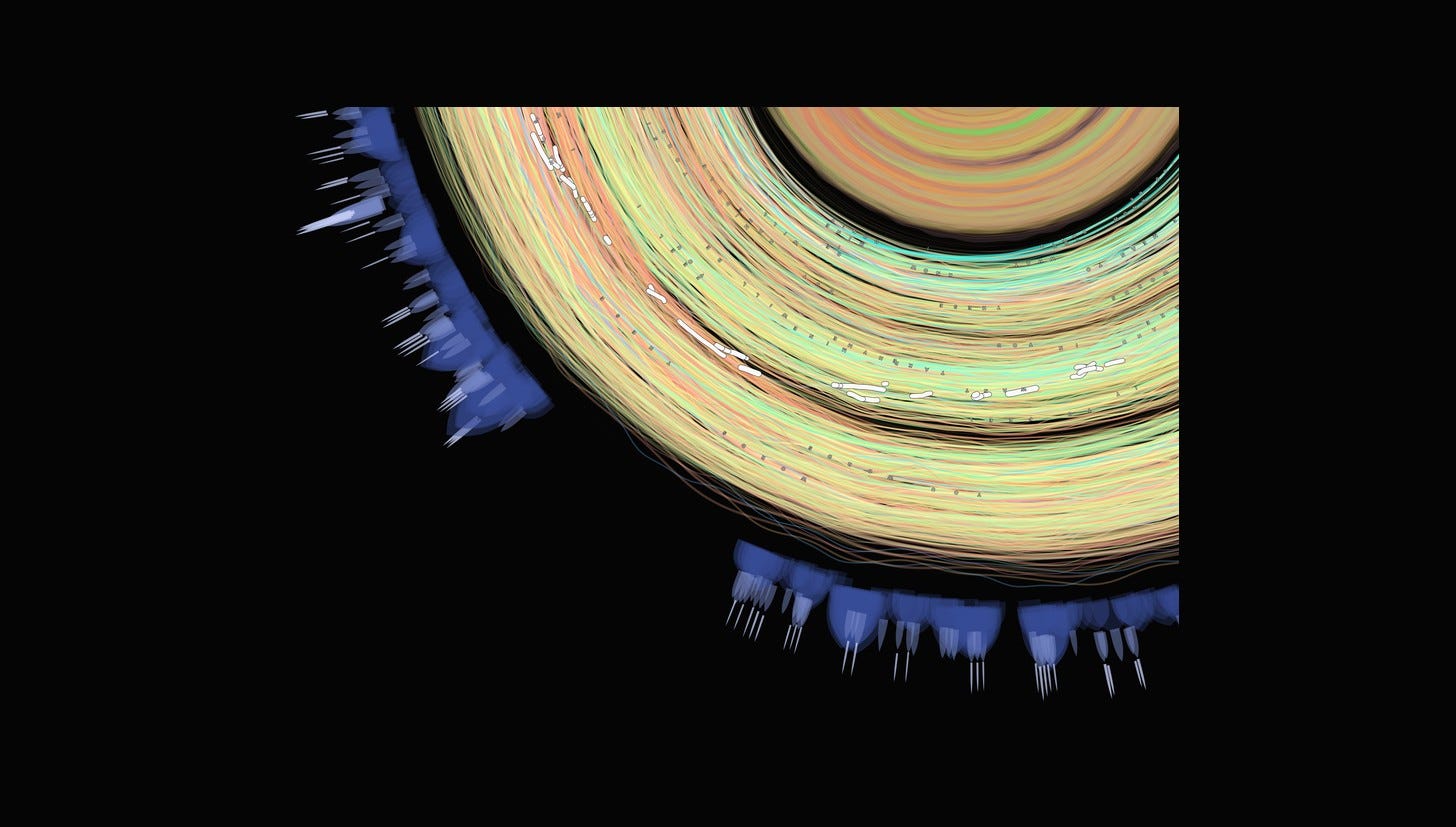
Into that gap, amid the sparsest singing on the record, he makes his case, spacing the words out across a lonely guitar line: Now with love come strange currencies. And here is my appeal. An appeal, a legal word, the word of someone pleading a case he suspects is already lost, delivered when the band has deserted him.
The drums return at 2:26, and what he does with their return is the tell: I need a chance, a second chance, a third chance, a fourth chance. A word, a signal, a nod, a little breath. He is counting his own worth down in ever-smaller units. A whole chance, then fractions of one; a word shrinking to a nod shrinking to a breath. That is the strange currency, the exchange rate of a man who will accept less and less while he needs more and more.
He comes back, of course. That’s the disease of the song. And the geometry keeps its cruelest fact for the end: the very end is where he sings the most, and the loudest.

The loudest moment of the entire track lands ninety percent through, and the final stretch carries more of his voice than anything before it, the one place the deliberately murky Monster mix lets the voice fully up. That’s not resolution. That’s These words, they haunt me, hunt me down, the same sentence, you will be mine, that he’d been wielding like a verdict, turning around to hunt him. The words he kept repeating to convince the other person were only ever convincing himself, and by the end they have him by the throat.
That is what The Bear heard when it made this song its own, a series about people who cannot stop reaching for the thing that keeps not being given: a man standing exactly where he was, saying the same words louder, spending the last of what he has on a claim that was never his.
Listen: Spotify | Apple Music | Amazon Music | YouTube