


Everyone who loves this song loves it for one sensation: the moment the floor tilts. You are standing in your own kitchen, your own marriage, your own body, and a voice starts asking how you got here, and suddenly you cannot answer. That vertigo is the whole song, but it is only half of what the song does. David Byrne wrote the verse like a man trying to talk his way back to solid ground, that flat televangelist stammer, hands chopping the air; and then, every time, the chorus opens like a door onto water and he stops fighting. Once in a Lifetime is the conflict between those two states, panic and surrender, and the sonicture draws it as one long look down into a current.
Because that is what the image is. Not a wheel, not a target: an eddy. The rings spiral in gold-green and amber and spring green toward a still sage eye at the center, and the whole surface has the grain of moving water photographed from above.
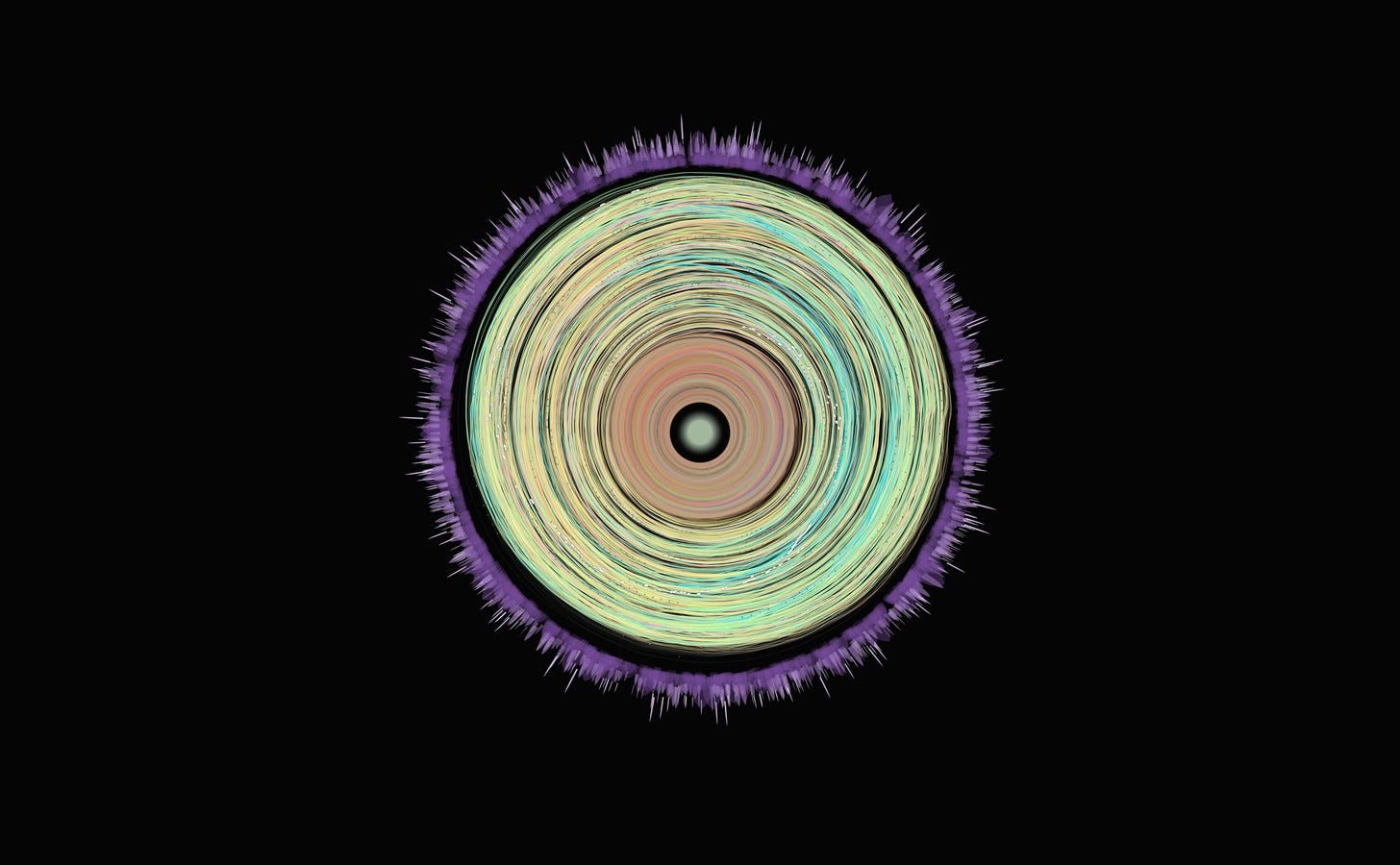
Start with what refuses to move. The whole portrait sits inside one family of the palette, gold-green, amber, spring green, with a vein of cerulean threading through. That’s D, G, A, and F#: the plain diatonic bones of D major, and almost nothing else. The verse is famously one chord, a loop Brian Eno and the band built out of a jam on Remain in Light, Fela Kuti’s Afrobeat pulled into a Manhattan studio in 1980 and set to circling, and you can read the crowding in the marks: 889 sharp attacks over 511 available beats, nearly two hits for every one the meter offers. The surface is all motion. The harmony under it barely breathes. The ground the man is standing on is, from first bar to last, same as it ever was.
So the stillness is not the revelation. The revelation is the edges.
Through the first two-thirds of the record the rings will not sit still. Their borders ripple and fray, wavy where you would want them clean, the harmonic tension riding close to its ceiling and staying there. That is the verse. That is the stammer. And you may ask yourself, “Well, how did I get here?” The confusion builds, “This is not my beautiful house”, “My God, what have I done?”, and the harmony refuses to move an inch under any of them, which is precisely the horror of it: the edges shake because the man cannot find rest, and the ground will not change to give him a reason.
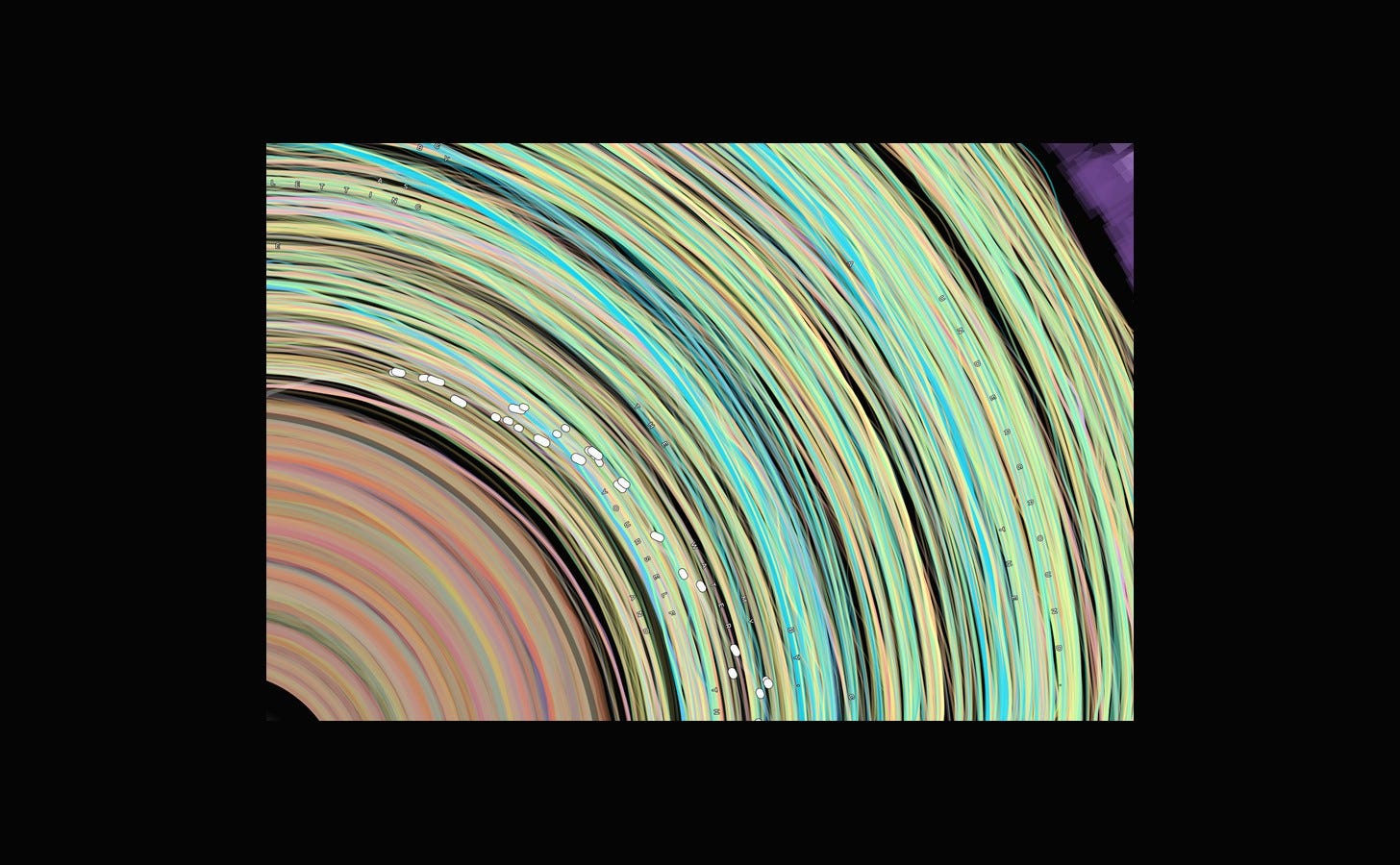
Deep in the song, about two-thirds of the way through the rings, just before the three-minute mark, the shaking spikes one last time, as if the panic comes back for one more grip. It is the last time the song holds that much tension. After it, everything drains. In the final stretch the edges go smooth, and the rings settle into the clean, resting geometry they never once managed while the questions were being asked. Nothing in the harmony resolved to make this happen; D is still D. What resolved was the man's relationship to the ground beneath him. He stops fighting the loop. Letting the days go by. The wobble was never the chord. The wobble was the panic, and the panic lets go.
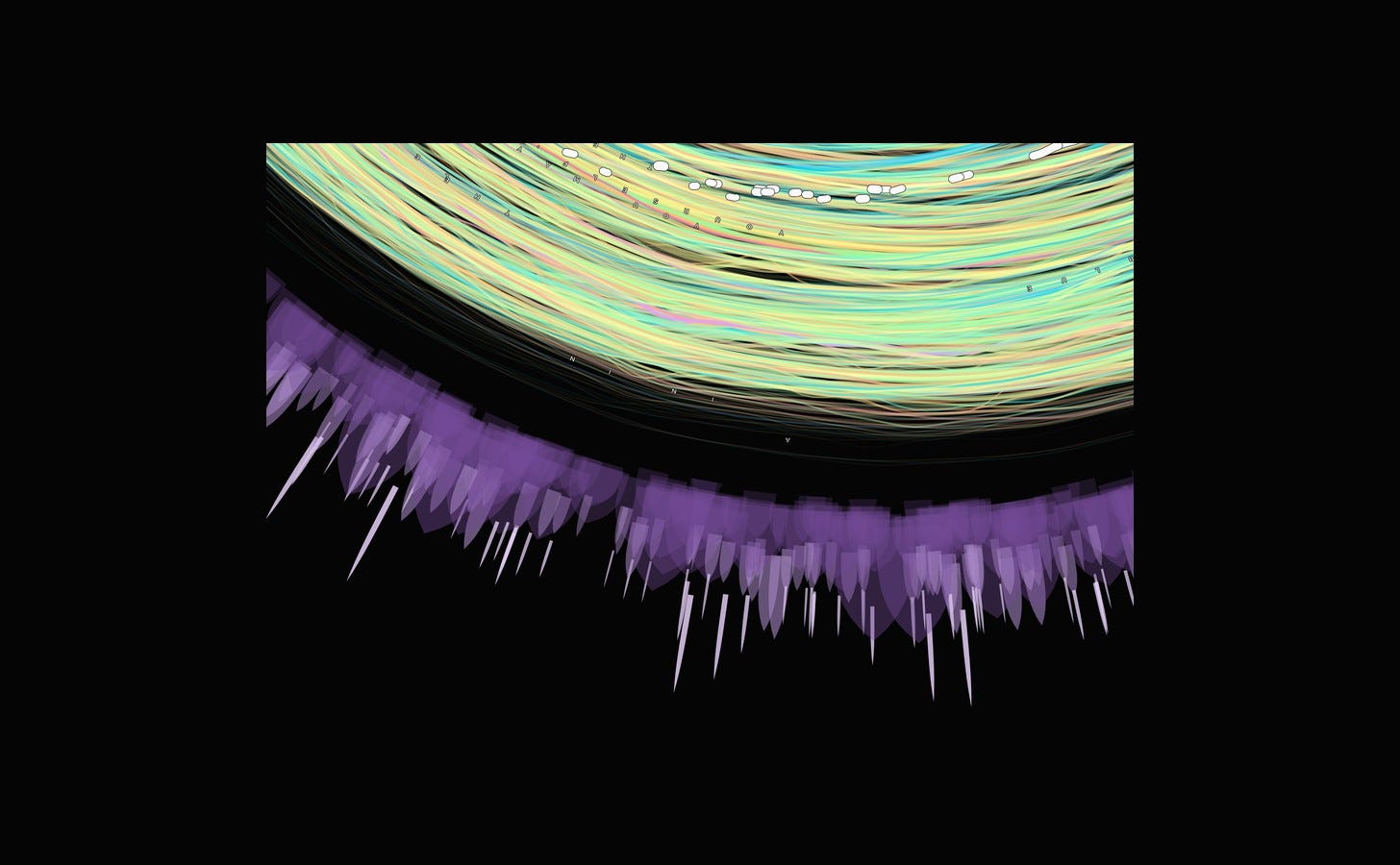
And here is the thing only this song does. Its loudest moment does not arrive with the most tension; it arrives with the least. The peak lands deep in that final calm, around three and a half minutes in, inside a seven-second stretch where the voice has dropped out entirely. After all the words, all the questions hurled at the ceiling, the biggest sound in the record is wordless. The swell comes, the voice is not there for it, and the edges stay clean straight through it. Volume alone would never show you this release, because the song does not get bigger to let go. It gets smoother. The surrender is not quiet; it is the largest thing in the song, and it has the calmest edges.
And through all of it runs the white thread, the voice. Byrne barely stops: some five hundred words inside four minutes, and the thread stitches through the rings nearly the whole way out, never quiet for more than a breath. That constancy matters. The questions are the most human thing in the song, and they do not let up; the asking runs right alongside the groove from the first ring toward the last. Which is what gives those seven silent seconds under the swell their meaning: the only time the voice truly steps aside in the whole record is the moment the water rises to fill it.
The percussion is the one cool thing in the frame, a violet corona at the rim, drawn in the complement of all that green, ringing the pool like static around a signal, restless the whole way through.
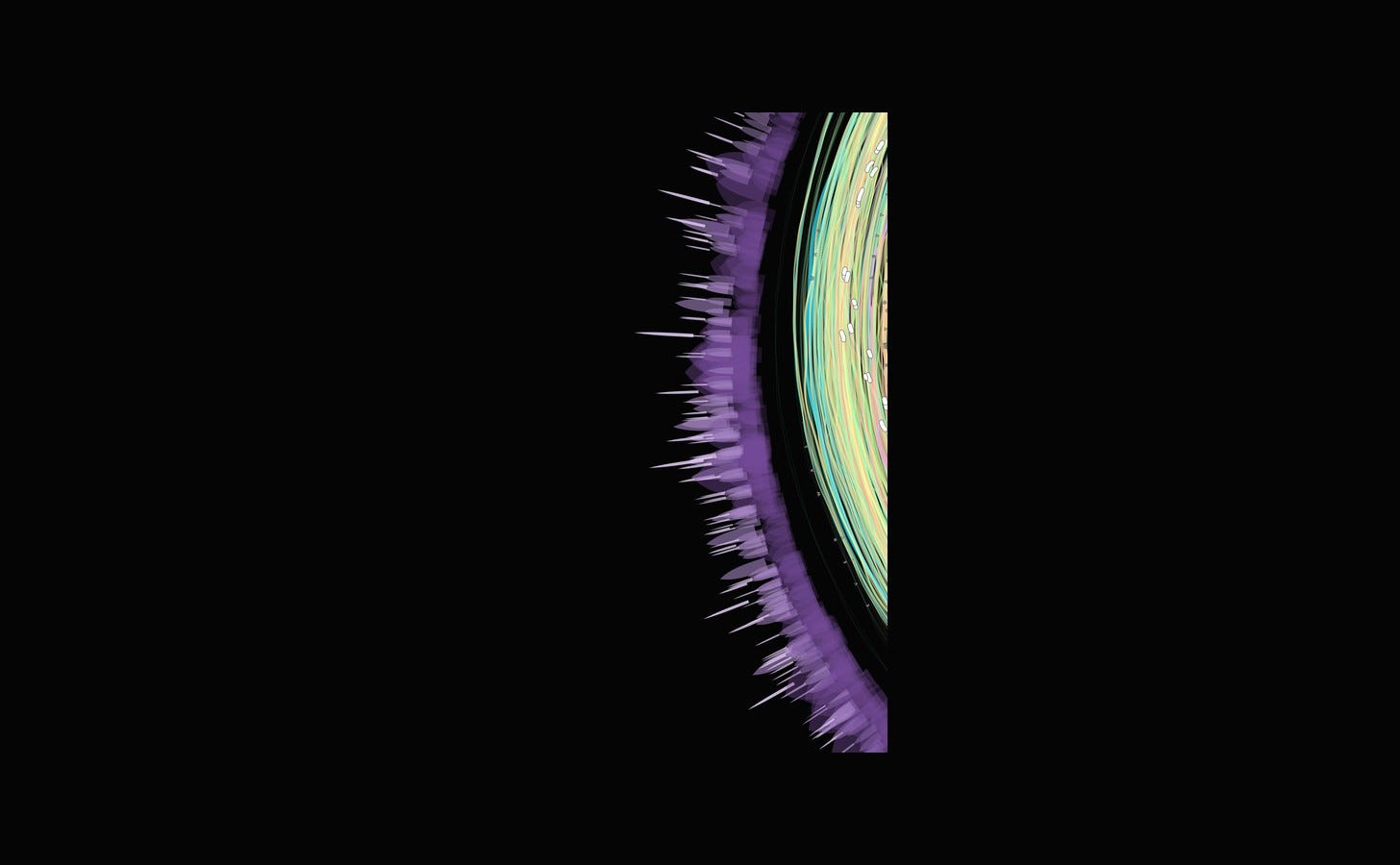
That is the whole shape. A pool that goes nowhere, a man thrashing at its edge, and the moment he lets the water take him, the loudest and the stillest he has ever been, at once. You already knew surrender was the point of the song. Now you can watch it happen: the edges stop shaking. The tilt was never in the ground. It was in us, and it passes. Same as it ever was.
every mark comes from the song.
to read a sonicture: learn · to watch one drawn: reveal