


How beautiful to be state of emergency, and then the turn that makes it a comfort instead of a cry: is where I want to be. Björk sings crisis as the place she most wants to stay. The song is dedicated to her oldest friend, the Jóga of the title, the person who holds you when the ground gives way. So you expect the sonicture to put the upheaval at the peak, the beats at their most violent exactly as the voice reaches the word emergency.
It doesn’t. And that inversion is the whole song.
Start in the middle. The core is warm, gold-green folding into amber, a small still hearth, and out from it the rings turn iridescent, violet and jade and sky-blue and teal braided so tightly that no single color takes the field. That’s true to the ear and true to the count: the three pitches carrying the most weight, Ab in soft violet, A in spring green, E in jade, sit within a single percentage point of one another. Ask the analysis what key this song is in and it declines to commit; with three centers this close, nothing owns the harmony. It’s the string octet Björk built the album around, warm arrangements written to be Iceland as sound, and the portrait shows exactly that: a woven, shimmering field where the melody lives in the blend rather than in any one voice.
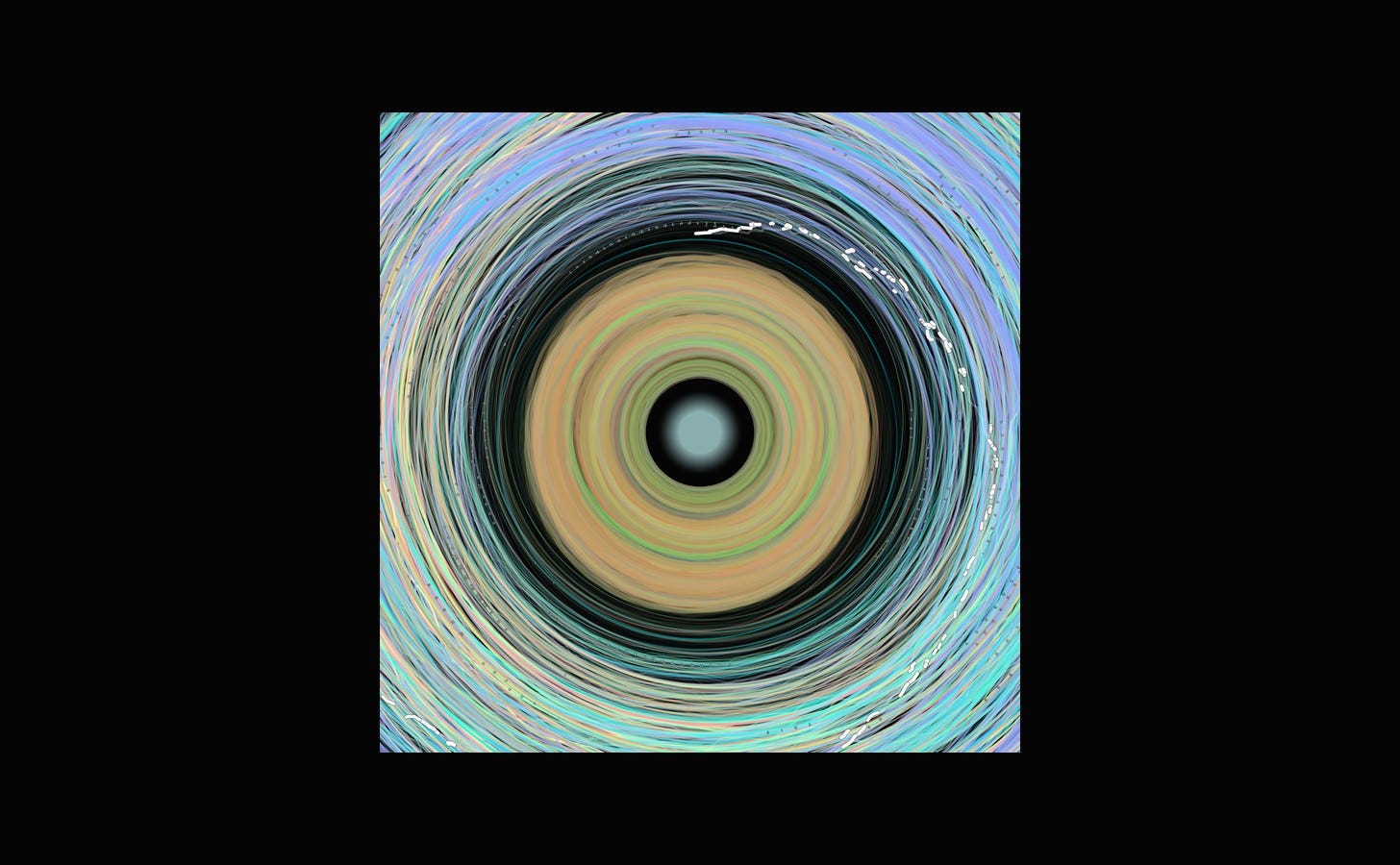
Now look at the edge. Ringing the entire portrait, radiating out into the black, are marks the color of fired clay, rust and terracotta and pale bone. These are the beats, and the sonicture draws them in a palette that belongs to no pitch, no string, no melodic color anywhere inside the rings. They are made of different material. That is the truest thing the image says about Jóga: the string arrangement and the beat are not blended, they are geologically separate substances. Björk described these beats as volcanic, cracked, tectonic, meant to sound like landscape rupturing rather than a drum keeping time. Here they erupt at the rim itself, launched from the outermost ring's edge, earthen against the cool woven interior, the eruption you can see happening at the surface of something otherwise serene.
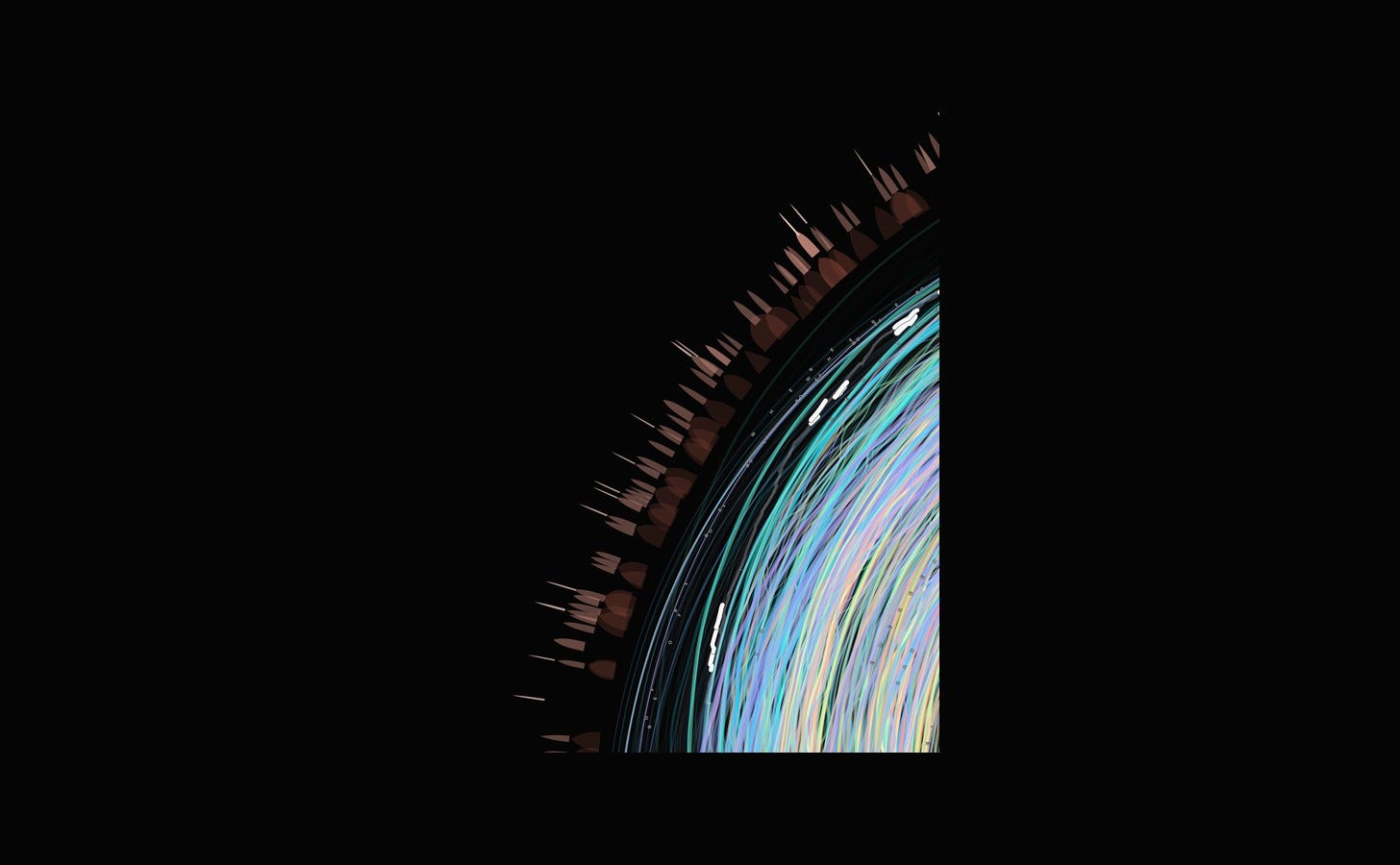
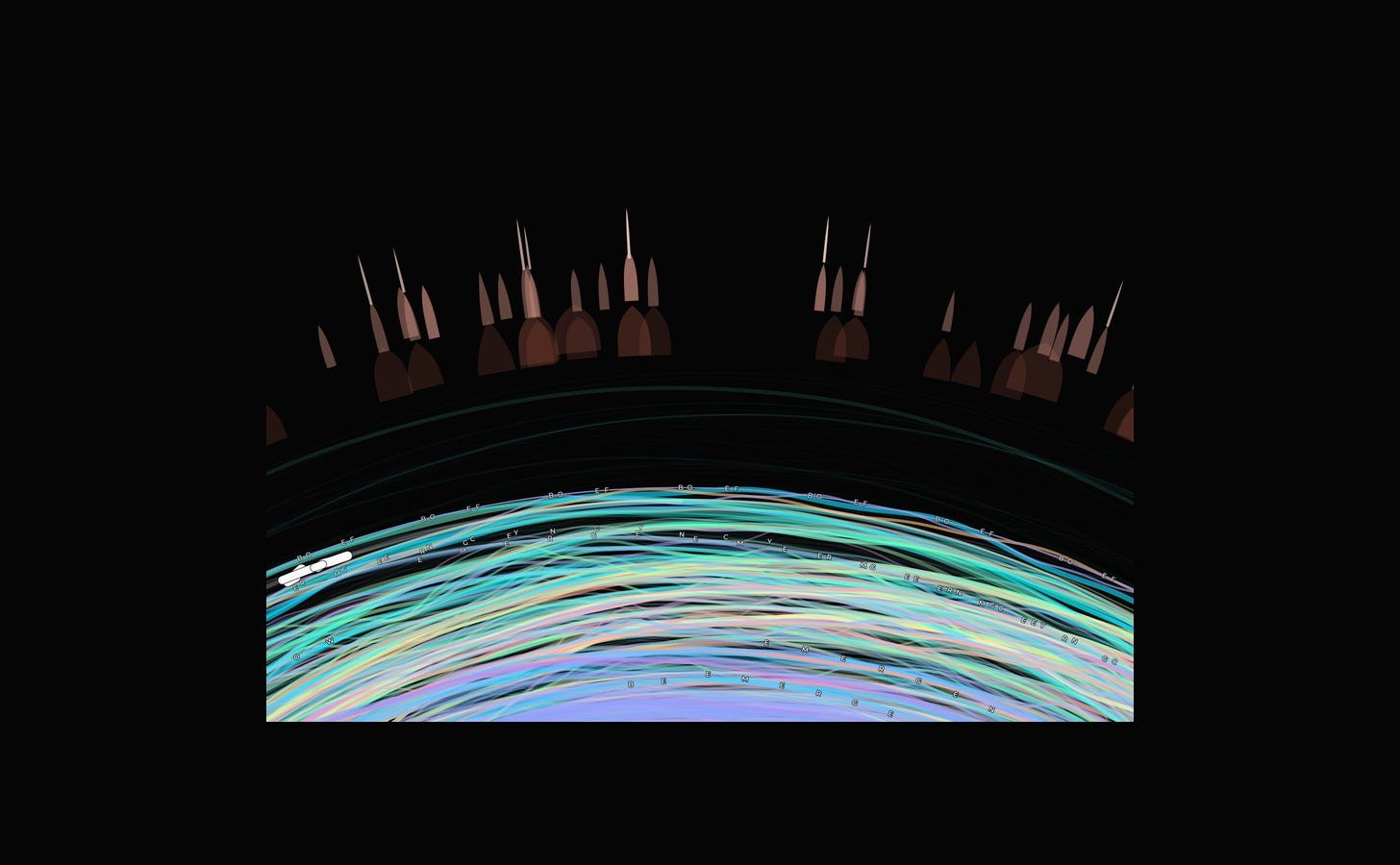
So far this is a portrait of contrast. The revelation is what happens to the two materials over time. The wobble, the wavy, unstable ring edge that marks harmonic tension, hits its worst near the top of the song, about a fifth of the way in, before the word emergency has been sung as anywhere you’d want to be. Early on the harmony is straining. Then follow the beats forward. Around three and a half minutes in, the clay marks crowd to their thickest, the most percussively violent passage in the whole song, and precisely there the ring edges settle to their smoothest of the entire portrait. Edge texture is a quiet signal, nearly imperceptible to the naked eye; the settling is measured, not watched. What the crop below shows is the meeting point: the back third’s outer rings running clean and smooth while the clay marks erupt just beyond them, rupture and rest side by side. The tectonic activity climbs; the harmonic edges come to rest.
That is not a contradiction the sonicture failed to resolve. That is the thesis. And you push me up to this state of emergency, and the push, when it fully arrives, does not read as strain. It reads as calm. The crisis and the stillness are drawn in the same moment. Emergency, at its loudest, becomes the place the harmony stops fighting.
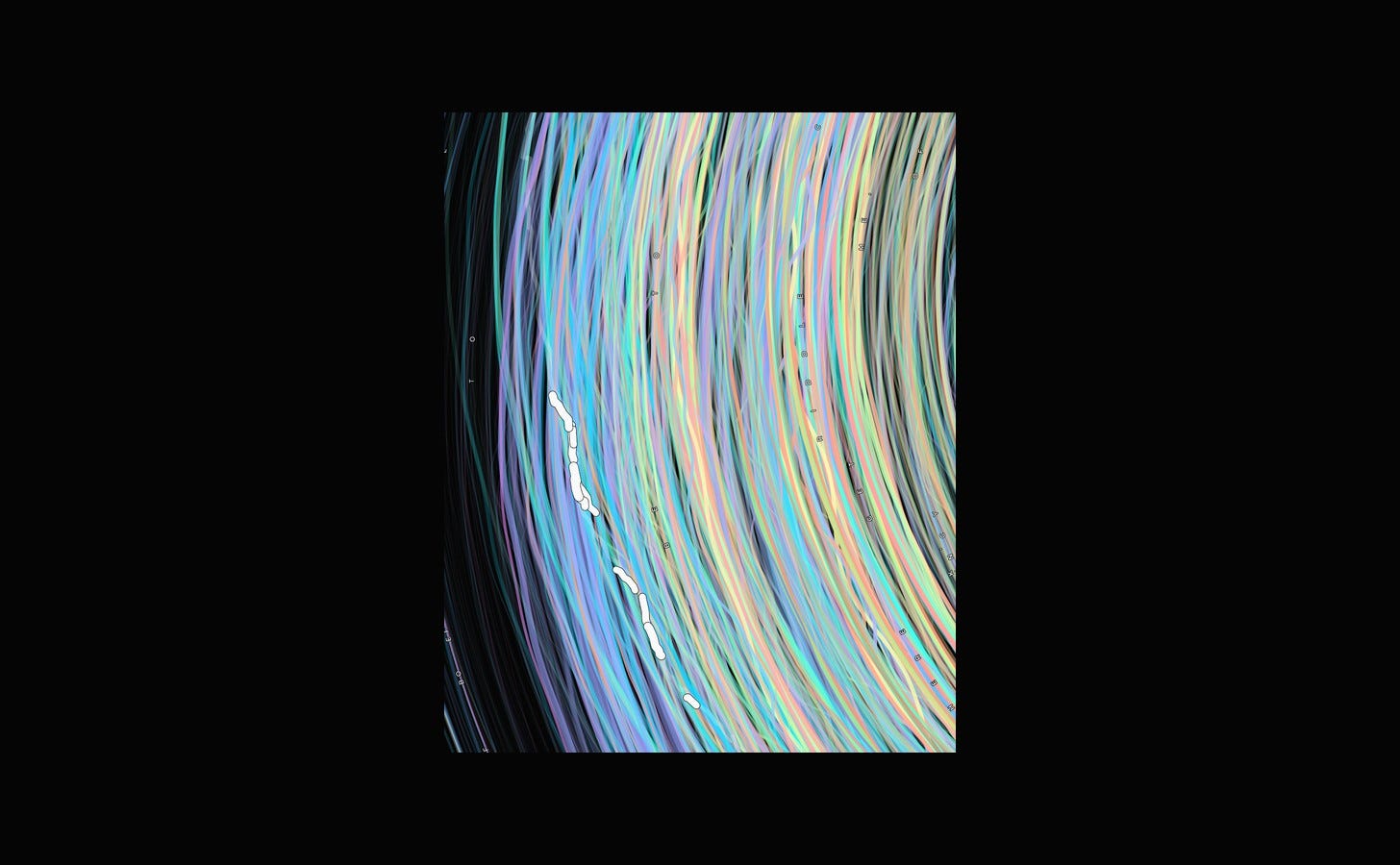
The white thread that traces the voice comes and goes across all of this, surfacing in bright broken arcs rather than one continuous spiral, a melody that sings, drops into the string field, and returns. And when it surfaces, it leaps: the line spans twenty-six semitones, more than two octaves, so the thread does not wander, it jumps. Every nerve that hurts, you heal, it says, and the healing is addressed to the one you call when everything is upheaval. Coincidence makes sense only with you. The friendship is the thing that makes the emergency livable, the still core that lets the surface erupt without the center giving way.
Play it again and watch the two worlds refuse to merge: the cool woven strings that never rupture, the clay beats that only rupture, and between them a harmony that grows calmest exactly when the ground breaks hardest.
How beautiful to be. She meant it.
every mark comes from the song.
to read a sonicture: learn · to watch one drawn: reveal