


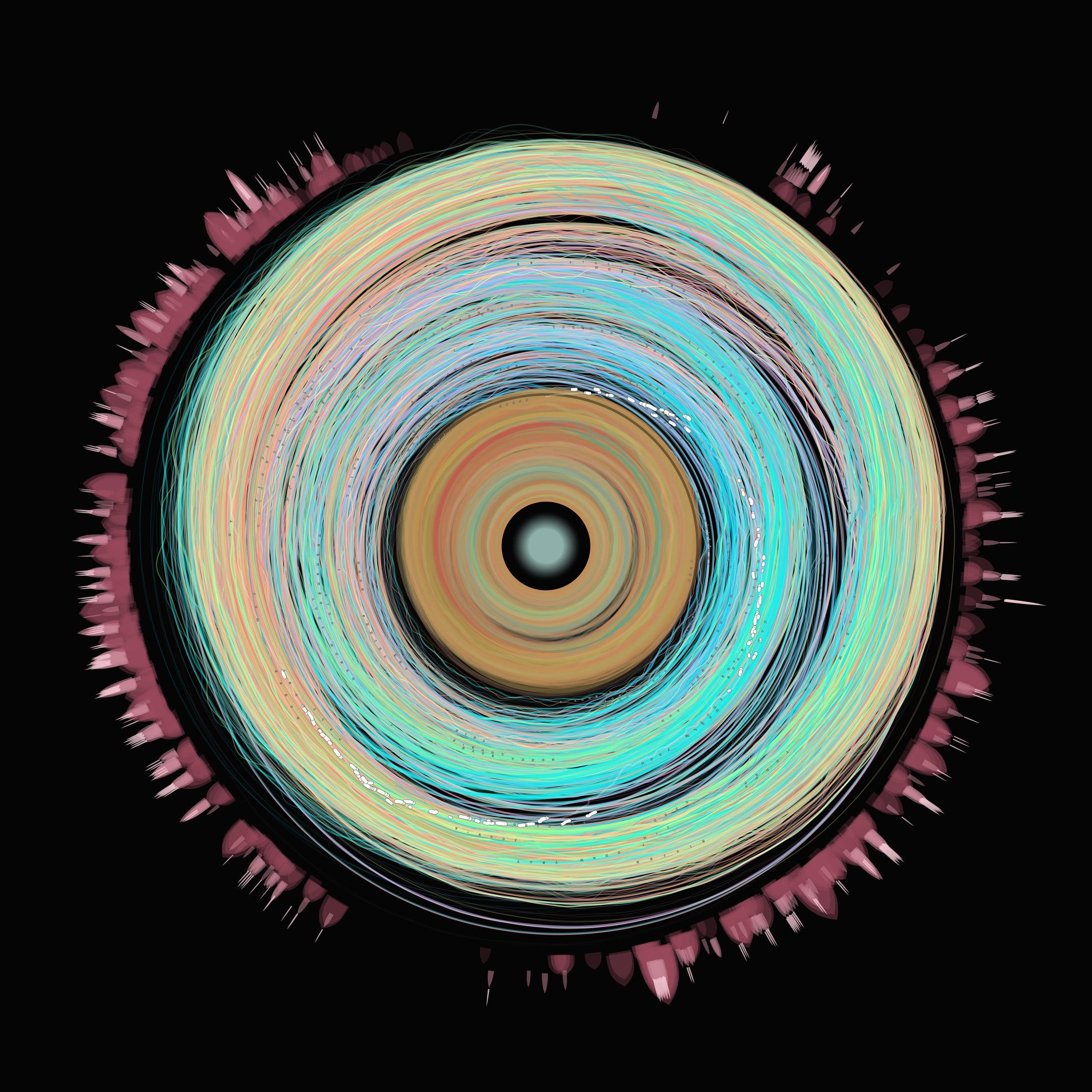
The song is a man talking himself down off a ledge and losing the argument in words before he wins it some other way.
Every verse is a fresh count of grievances, each one flatter than the last. Nobody’s honest, he says, then Nobody’s true, then the admission that closes off every escape: I’m the same way too. By the time he reaches And the weight of my worries / Is too much to take on, the case against hope has been made and made well. This is where you might expect the sonicture to flinch. Instead the tension is held in the song’s opening, on the sparse acoustic guitar and the first word of the first grievance. The strain isn’t in the argument. It’s in the voiceless strumming he starts from.

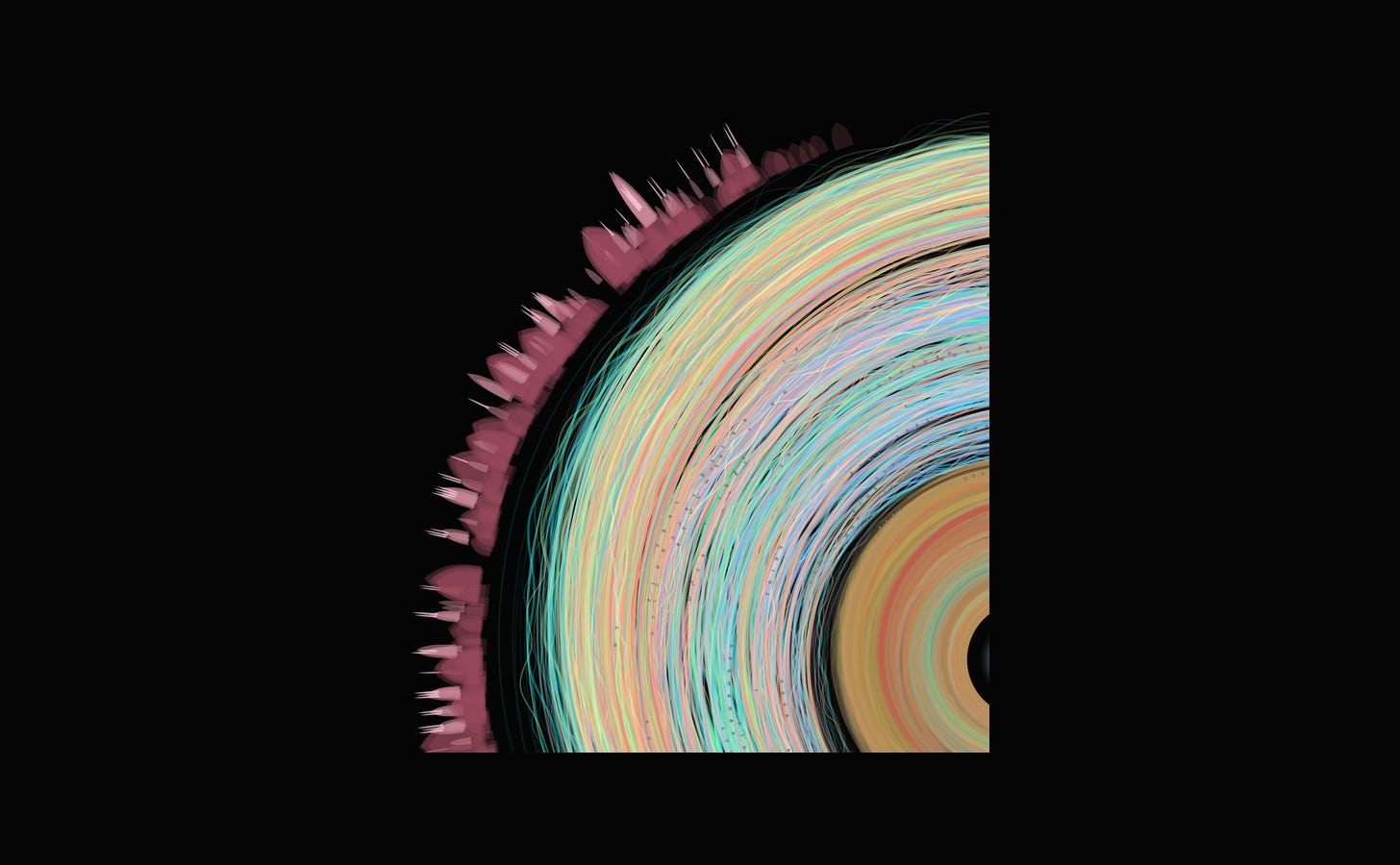
The drums don't reach full density until late. Read the percussion clockwise from the top and the launch surface stays nearly clean through the first minute, then thickens as it circles the wheel, the band assembling itself around a man who began alone. Those marks are drawn in dusty rose, a muted mauve pulled from the complement of the piece's central DNA. They circle a coral core of warmth, and the warmth might be the tell.
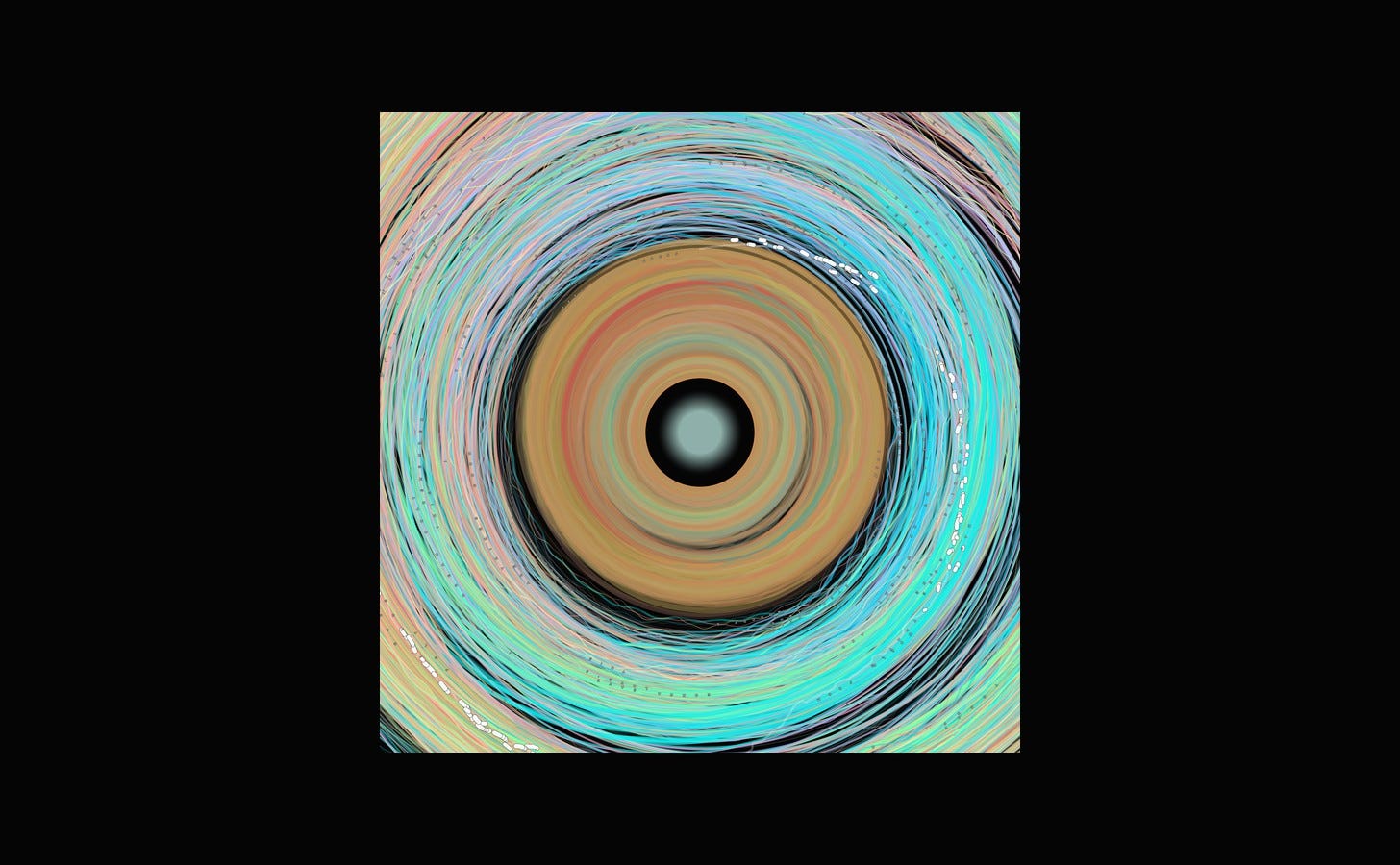
Because here is the line the whole song is built to arrive at: But I know that I’m open / And I know that I’m free. The turn. The place disillusionment is meant to break into daylight. But if this was the moment, the geometry might confirm it, the harmony might swing home, or the rings might snap concentric and resolve.
They don’t. Not there.
The song’s integrity depends on a truthful reading: the dynamics turn where the lyric turns; the harmony does not. Coral C anchors the entirety, the pitch centre barely moves, a teal B in the front giving a little ground to a spring-green A by the end, nothing that might read as arrival. The rings lean only modestly; the harmony pulling away from the tonic and never returning in full. What does move is the band. Under The future is fading / And the past is on hold the drums have gone silent for seventeen seconds, the only gap on the rim between the opening and the fade, and they return with the inflection point: But I know that I’m open. And those final three sections are the song’s loudest, with the peak landing just before three and a half minutes, right as the last words leave. The resolution isn’t earned by the chords. It’s asserted by the band simply getting under him and pushing.
And then as words run out, watch the tense in the very last thing he sings: through every verse it has been I just feel like, present, ongoing, inescapable. The final line flips it, I guess I just felt like / Giving up today. Past. As if survived. As if the giving-up already happened and he’s naming it from the other side.

What follows is the argument's real answer, and it contains no words at all. For nearly a minute after that last line the white vocal thread simply ceases, the longest gap in the song by far, running almost to the close. Into it goes the guitar. This is the return to the blues that critics heard on Sob Rock, and it's doing something the lyric could not: it keeps climbing when the vocabulary of hope has been exhausted. And if I go blind I'll still find my way, he says it, and then he shows it, playing his way through the dark where the sentence stopped.
I Guess I Just Feel Like makes a spoken argument for hope, feels it fail as language, and then abandons the words to hand the affirmation to a guitar because a guitar can say I’m free without needing the words. The chords aren’t the resolve. The volume never quite explodes. The whole swell happens while the colour holds warm and coral, steady while other pitches crowd the rings around it in blush and teal and cerulean. A man whose harmonic home never wavered even as his faith in everything else did.
He guesses he just felt like giving up today. Then he played for a full minute past the sentence, and didn’t.
to read a sonicture: learn
to see a song-drawn sonicture: reveal
Listen: Spotify | Apple Music | Amazon Music | YouTube