


We know this song before the drumroll lands. The engine turn-over, the glockenspiel shimmer, the sense that the whole band has been holding its breath for years and is finally allowed to exhale at full volume. We gotta get out while we’re young. It is the most famous promise of escape in American rock. And here is what the sonicture knows that the promise hides: nobody ever gets out.
Look at the color. The body of the image is jade and teal, ring after ring of it, and jade is E, the home key, the tonic this song is bolted to. The data makes it almost comic in its insistence: of eighteen sections, E is the dominant pitch in fourteen of them. The pedal is floored. The key never leaves.
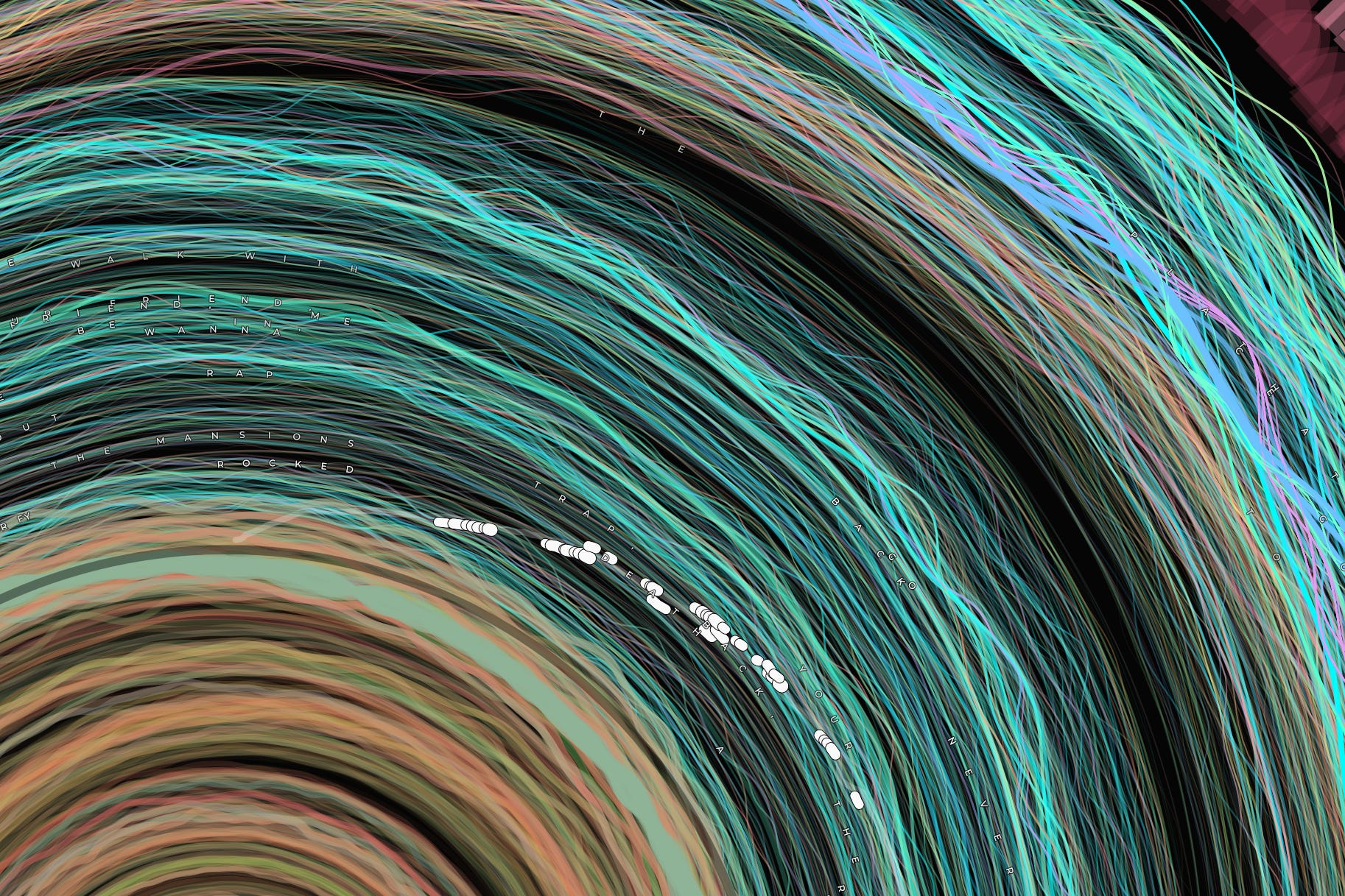
That is the whole ache of the song rendered in geometry. Oh, someday girl I don’t know when we’re gonna get to that place, the line admits the destination is unreachable, and the rings agree. They lean. The harmony pulls off-axis to about half its possible drift at the strongest pull, enough to feel the wanting, never enough to break concentricity. This is a song that mistakes motion for arrival, and the image is honest about it: all this momentum, circling.
Now the thing that should reorder how you hear it. Bruce Springsteen is, in our memory, singing this song, throwing his whole body at it. But the voice is present for 14% of the running time; the white spiral thread surfaces in the verses and the choruses and then vanishes for long stretches into the wall. Because that is what Born to Run actually is, not a singer with a band, but a band, a Wall of Sound built the way Phil Spector built them, that occasionally lets a singer up for air. The dynamic range is three decibels. Three. Everything is loud, always, the whole recording pinned to the ceiling. There are no soft moments to set the loud ones against; the song is one sustained roar, and the geometry shows it as rings that never thin into rest.
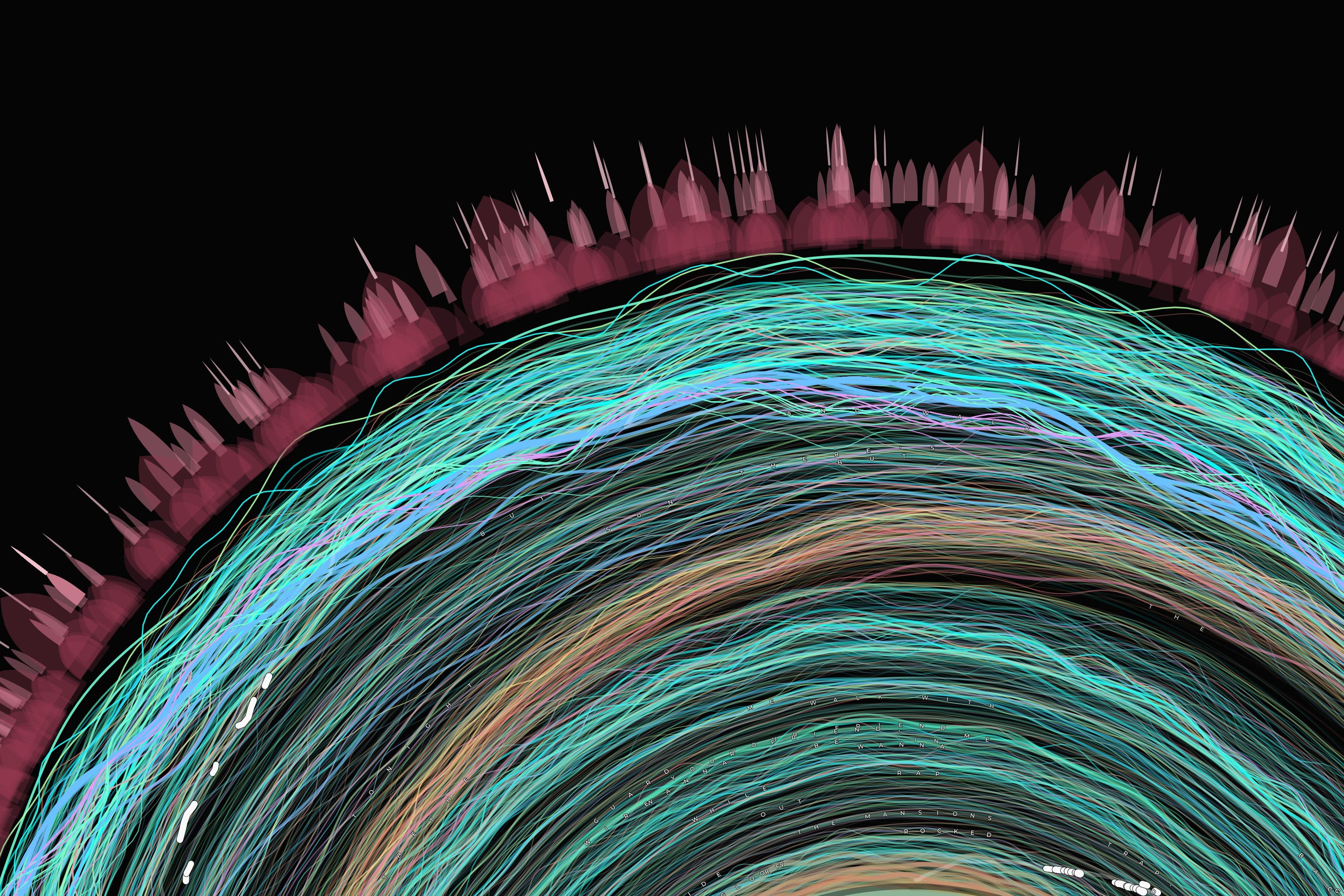
The roar has a maker along the rim. The percussion crown, dusty rose, the complement of this song's warm core, spikes around the entire circle, bottom-heavy, half its energy in the low band. That is Ernest 'Boom' Carter, who drummed on this track and then walked out before the rest of the album was cut, abandoning one of rock's greatest recorded performances. The man left; the drive he laid down runs on.
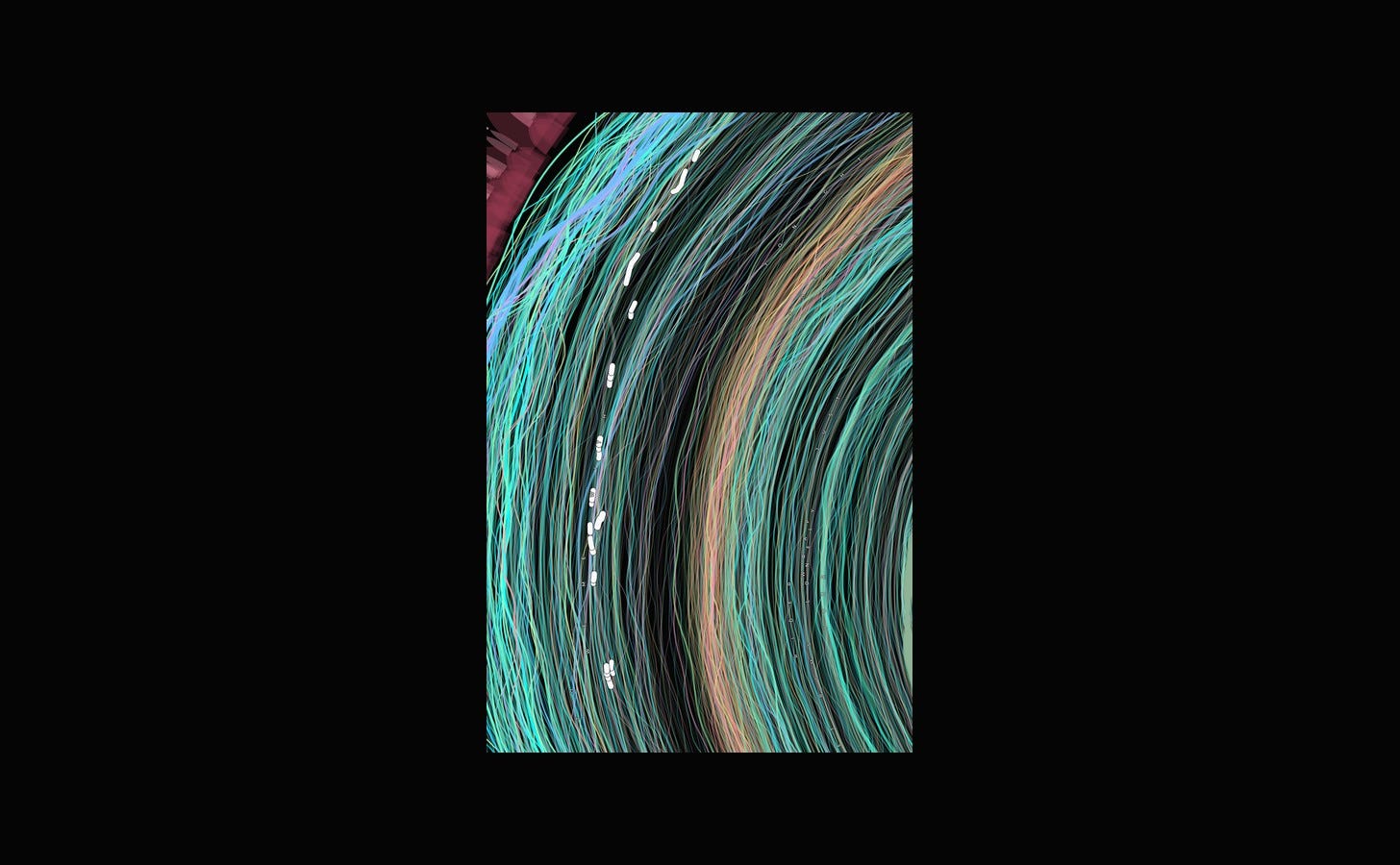
And then, for one moment, it rests. There is a place a little past the song’s midpoint where everything pulls back, the darkest band in the whole image, the lowest brightness reading of any section, the sparsest transients, fewest sharp attacks, anywhere in the song. This is the breakdown, the held suspension where Roy Bittan’s piano and the strings hang in the air and the band seems to gather itself. And it is, by the tension envelope, the most unstable point in the song, the ring edge here goes wavy, harmonic tension near its absolute maximum. The quietest moment is the most strained. That is the breath before the highway’s jammed with broken heroes on a last-chance power drive, the suspended count, one, two, three, four, and the whole machine slams back to full.
What it slams toward is the end, and the end is where the song finally tells the truth. The loudest moment of an entirely loud recording arrives at 88% of the way through, not at a chorus, not at the sax solo, but in the final stretch, the band cresting harder than it ever did before. The transient density climbs through the last three sections, denser, denser, densest at the close. And the words run out. Springsteen stops singing lines and the song rides out on pure wordless cry, oh, oh, oh, over and over into the fade, the language gone but the voice never leaving. Tension at the final section reads near maximum, the rings never settle into a clean, resolved edge. The song does not land. It accelerates into a held wail and fades while still running.
That is the secret the sonicture keeps for you. Together we could break this trap, we’ll run till we drop, baby we’ll never go back. The vow is to keep moving, and the geometry takes the vow literally, pinned to E, drifting but never free, voice surrendered to the wall, loudest at the moment it can no longer hold on, ending on tension instead of rest. The most exhilarating escape song ever recorded is a circle. You were never going to get to that place. You were only ever going to run.
every mark comes from the song.
to read a sonicture: learn · to watch one drawn: reveal