


Everybody knows the four words. They got chanted in the streets in 2015, over police tape and bullhorns, a whole generation using them to keep walking: we gon’ be alright. But an answer is only as strong as the question it survives. The sonicture shows me exactly where that question lives, a six-second hole in the middle of the song, and how narrowly the promise is made from inside it.
Start with color. The field runs warm and pale: coral, blush, gold-green, and a band of spring green threaded through almost every ring. That spring green is A, and A is home here. It carries more of this song than any other pitch, more than a fifth of the whole harmonic field, and it is the one note the song keeps coming home to. And the rings lean, visibly: the whole weave sits right of true center, a dark crescent opening at the upper left where the field pulls away. The lean is real, and it is going somewhere. But whatever pulls at this song, it keeps returning to the same green.
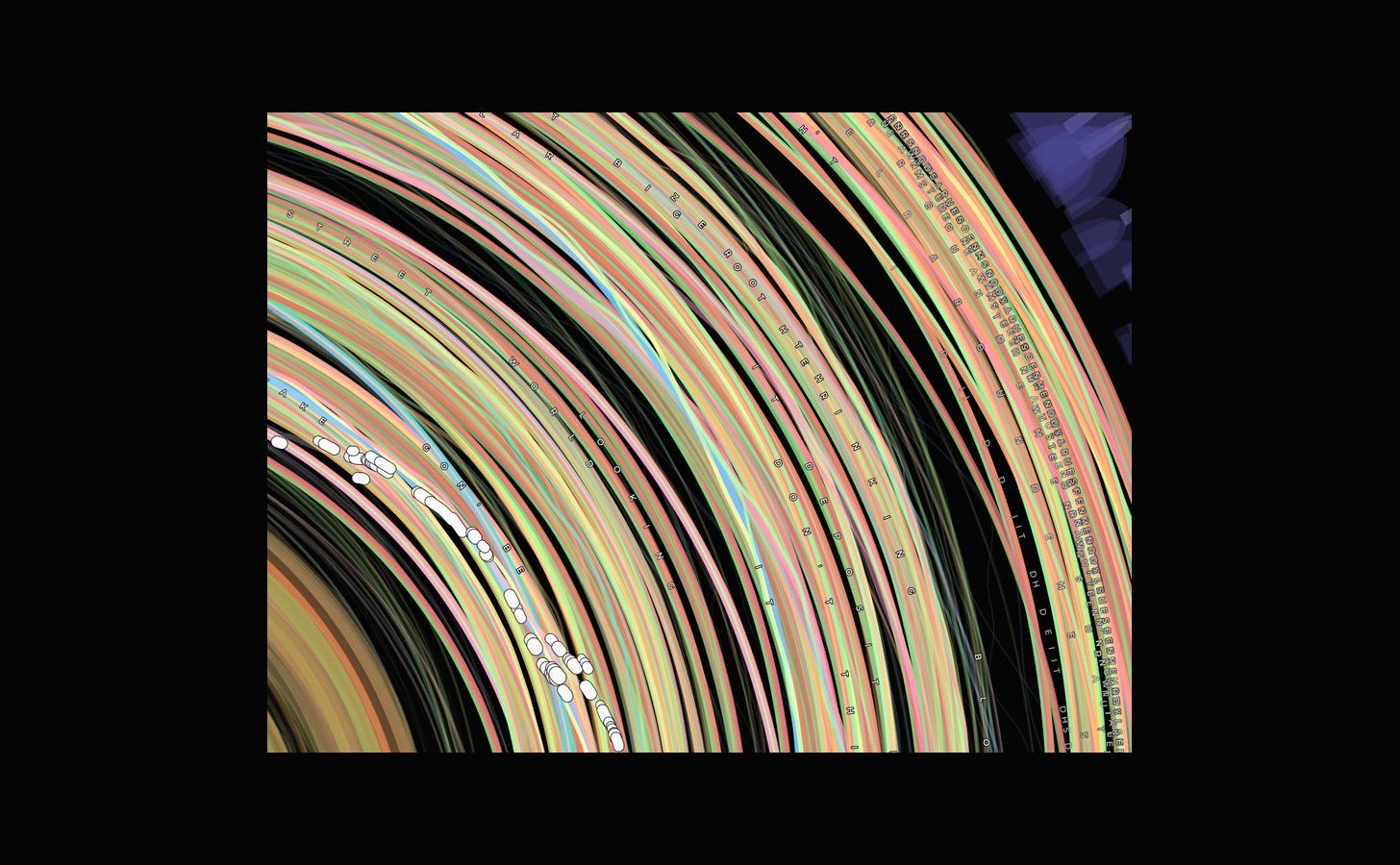
Trace the sections and you can watch the green reappear like a heartbeat: ten of the eleven sections list A among their dominant pitches. It’s there under Alls my life, I has to fight, nigga, where the edges already run wavy, the fight declared and the tension high from the first bars. The line itself is an inheritance: Sofia’s declaration from The Color Purple, forty years old, requoted as the song’s opening words, endurance handed down and picked back up. It’s there through every hook, every chant.
There is exactly one section where it isn’t.
Around 2:20, a six-second window, the shortest passage in the entire song, spring green falls out of the section’s leading pitches. Sky blue and gold-green hold the ground in its place. And this is not the only thing that changes here. In the same window the rings thin almost back to the sparseness of the intro, the loudness collapsing. The ring edges reach their most violent wobble of the whole piece, harmonic tension at its absolute ceiling. And the white vocal thread opens its longest silence of the song, nearly five seconds of nothing, right around 2:38.

Home color gone. Rings thin to almost nothing. Edges shaking. That is the sound of the floor going out from under a song, drawn as geometry. And it lands on the exact line where Kendrick stops performing and says the quiet thing out loud: I’m fucked up, homie, you fucked up.
This is why the hook works. It isn’t optimism sprayed over the top of the record. The despair is not avoided; it is entered. The song gives it its own room, the one place the ground pitch refuses to appear, the loudest wobble, the widest silence, and lets it be true.
And then, still inside that broken window, listen to what does not stop. The percussion. The drum marks radiate from the rim in cool violet, indigo petals crowding the edge, drawn in the center’s complement so they read as separate from all that warm color. Through the collapse, the rhythmic spikes stay at their fullest density, tied with the highest in the song. The harmony has let go of home; the pulse has not. The beat keeps firing into the dark.
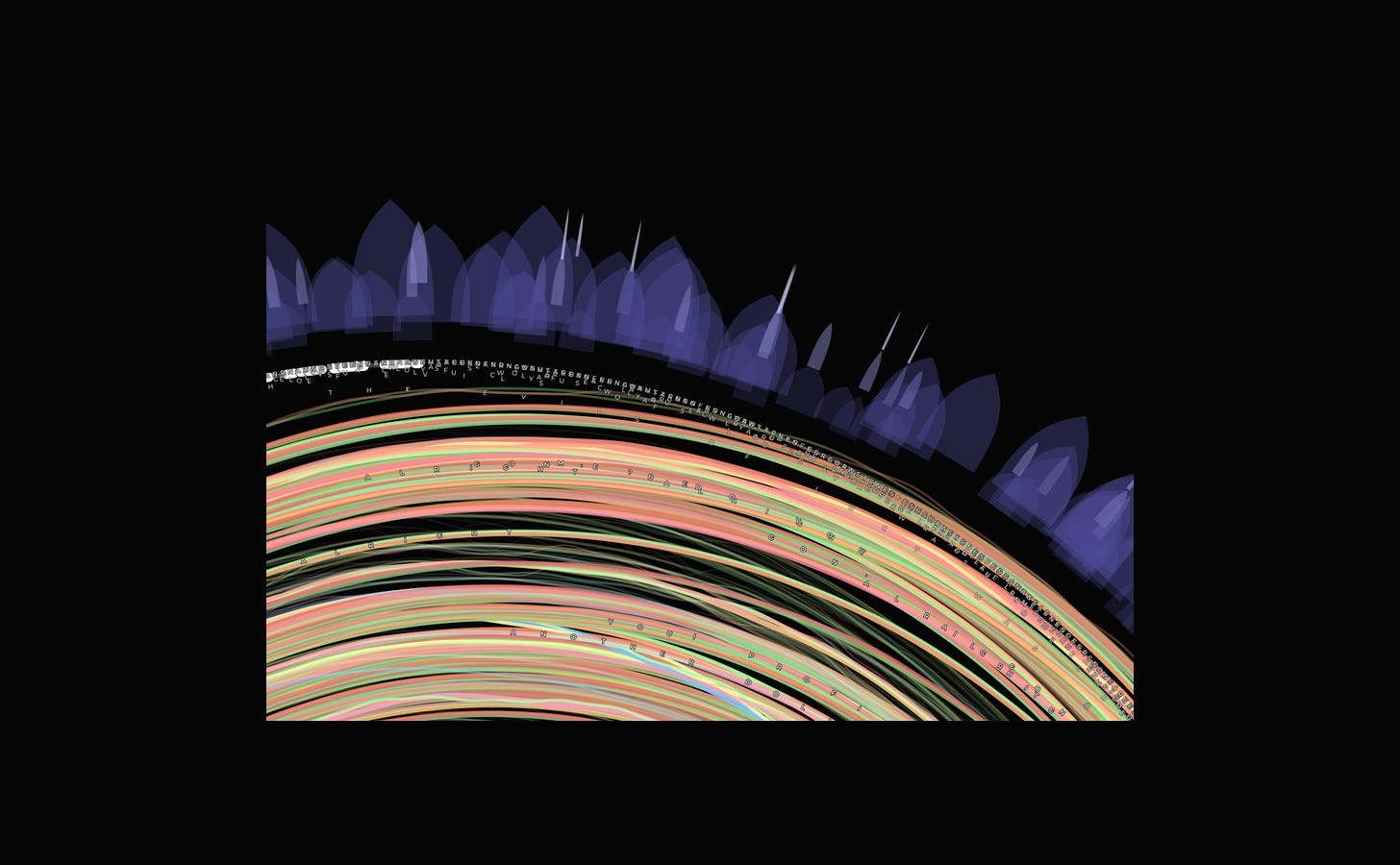
That is the mechanism of the whole anthem, and it belongs to no other song. The rhythm holds the floor the harmony dropped. It’s why the four words survive being chanted a cappella at a march with no track underneath, the meaning was never carried by the chords. It was carried by the pulse. Do you hear me, do you feel me? We gon’ be alright. You feel it in the body before you argue it in the head.
Out of that window the green comes back. A returns, the rings fill again, and the resolution arrives on the line that reframes everything before it: But if God got us, then we gon’ be alright. The promise is conditional and it is spoken from the bottom, not above it.
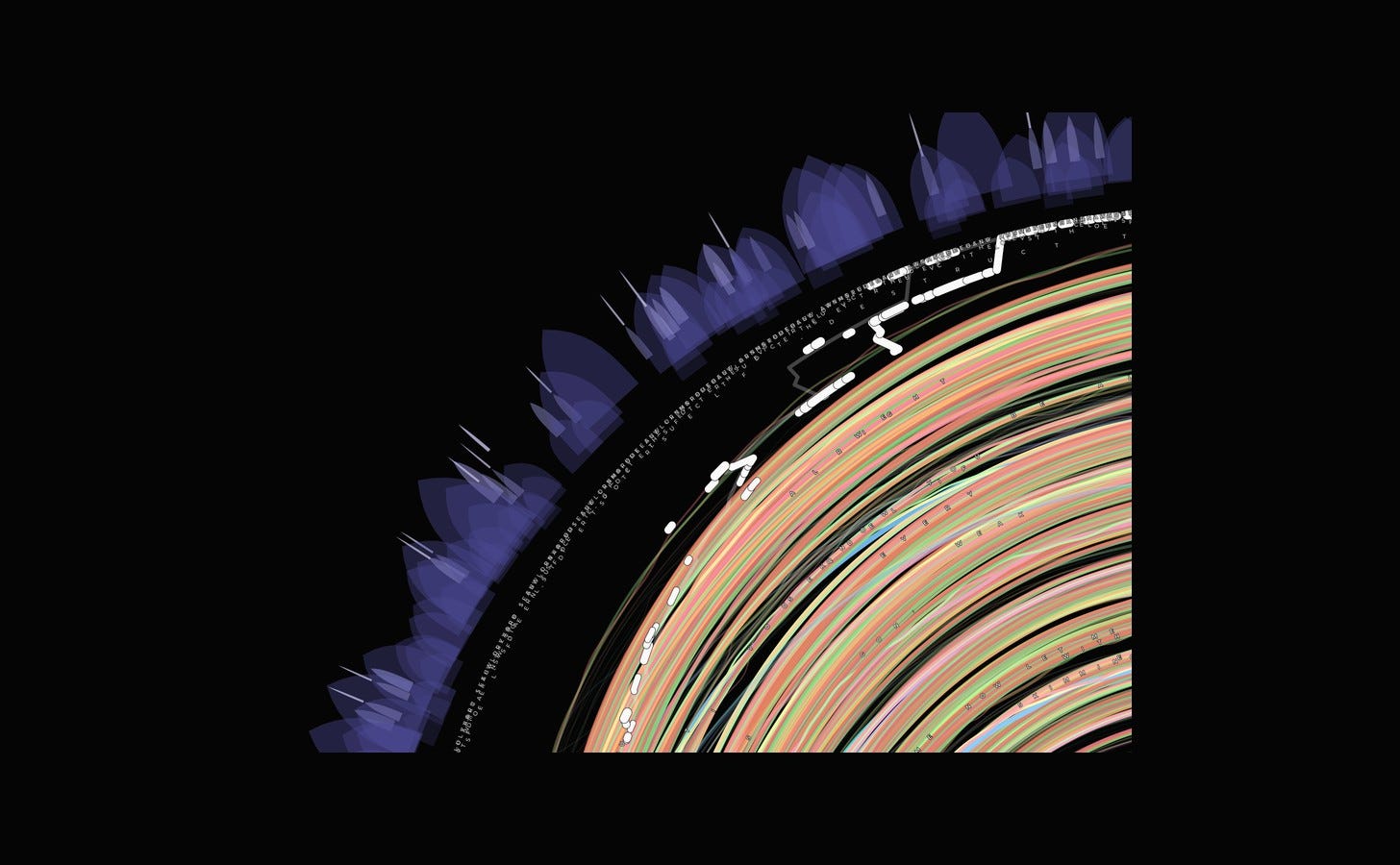
And watch where the geometry puts its weight. The single loudest moment of the song, its thickest rings, its peak, does not fall on any verse of temptation or despair. It falls about four-fifths of the way through, in the long final stretch where the affirmation is repeated and repeated until it becomes a floor of its own. The song spends its whole architecture climbing toward the place where the four words are simply true, and it puts its maximum weight there, at the end, after the collapse, not before it.
And then the song stops singing. The last forty seconds of the track are spoken, the poem that stitches To Pimp a Butterfly together arriving mid-thought: I remember you was conflicted, misusing your influence. On the portrait this is the strangest stretch: the outermost rings run thin and quiet while the engraving runs dense, more words crowding the rim than anywhere else in the circle, speech piling onto sparse rings. And it is exactly here that the lean finishes its journey. The drift peaks inside the poem, the rings pulled furthest off center, so far that at the upper left the disc opens into black and the words float alone in the void. The song ends off balance on purpose. The question the hook survived is handed forward to the rest of the album, still open, still walking.
The despair gets six seconds. The green gets the rest of the circle. Nazareth, and we gon’ be alright.
every mark comes from the song.
to read a sonicture: learn · to watch one drawn: reveal